

If you can feel the water pressure hitting your shingles, you're likely watching the lifespan of your roof disappear right before your eyes. It's a common misconception that more power results in a better clean, especially when those unsightly black algae streaks begin to diminish your home's curb appeal. You probably worry that a standard cleaning might blow shingles loose, void your manufacturer warranty, or that chemical runoff could endanger your family pets and prized landscaping. These are valid concerns for any homeowner who takes pride in maintaining a beautiful, lasting property.
This comparison guide identifies why soft washing is currently the only manufacturer-approved safe roof cleaning method to protect your investment and keep your home value high. We'll walk you through the technical differences between high-pressure and low-pressure systems while addressing the latest 2026 safety regulations from OSHA and the EPA. By the end of this article, you'll understand how to achieve a streak-free, professional finish that prioritizes the structural integrity of your roof and the safety of your entire estate.
Key Takeaways
- Learn why high-pressure water is not a safe roof cleaning method because it causes permanent granule loss and accelerates the aging of your asphalt shingles.
- Discover how soft washing utilizes gentle, manufacturer-approved chemistry at approximately 60 PSI to decontaminate surfaces without the risks of mechanical force.
- Understand the professional protocols for property protection, including the use of biodegradable cleaning solutions and the safeguarding of sensitive Bucks County landscaping.
- Identify the specific biological threats like Gloeocapsa Magma and moss that compromise roof integrity and require targeted treatment rather than simple rinsing.
- Gain confidence in selecting a service provider by understanding the importance of full insurance and the use of professional-grade equipment for exterior restoration.
The Risks of Traditional Cleaning: Why High Pressure is Not a Safe Roof Cleaning Method
Many homeowners assume that if a pressure washer cleans a driveway effectively, it must be the right choice for a roof. This assumption is dangerous. High-pressure water is inherently destructive to asphalt shingles because it relies on mechanical force rather than safe chemistry. The Asphalt Roofing Manufacturers Association (ARMA) specifically advises against high-pressure cleaning, noting that it can drastically shorten the lifespan of your roof. For those looking for a safe roof cleaning method, understanding the technical reasons behind this industry standard is the first step toward protecting your home's value.
The Hidden Danger of Blasting Shingle Granules
Asphalt shingles are coated with ceramic-coated stone granules for two critical reasons: UV protection and fire resistance. These granules act as a shield, preventing the sun’s harsh rays from drying out the asphalt and causing the shingles to become brittle. When a high-pressure nozzle is directed at these shingles, it acts like a sandblaster, stripping away this protective layer. In fact, a single afternoon of aggressive pressure washing can cause as much granule loss as ten years of natural weather exposure. Shingle granule loss is a primary cause of roof failure because it leaves the underlying asphalt vulnerable to cracking and curling.
Water Intrusion: When the Cleaning Causes the Leak
Beyond surface damage, high-pressure cleaning presents a significant risk of internal water intrusion. Standard shingles are designed to shed water that flows downward with gravity. They aren't built to withstand 3,000 PSI of water directed upward or sideways. This force can easily lift shingles, breaking the delicate sealant bonds that keep your roof watertight. Once these bonds fail, water is forced into the underlayment and the roof deck, leading to wood rot, mold growth, and interior ceiling damage. Understanding how pressure washing damages shingles helps explain why professional exterior restoration specialists focus on decontamination rather than force. High pressure can saturate the structural layers of your home before you even notice a drip.
Finally, there is the matter of your financial protection. Most major shingle manufacturers, including GAF and Owens Corning, explicitly state that pressure washing voids their warranties. If you experience a leak or failure later, the manufacturer can deny your claim if they find evidence of high-pressure cleaning. Choosing a method that aligns with these manufacturer standards is the only way to ensure your roof remains protected both physically and legally. You don't want to trade a dirty roof for a voided warranty and a compromised structure.
Soft Washing vs. Pressure Washing: A Side-by-Side Safety Comparison
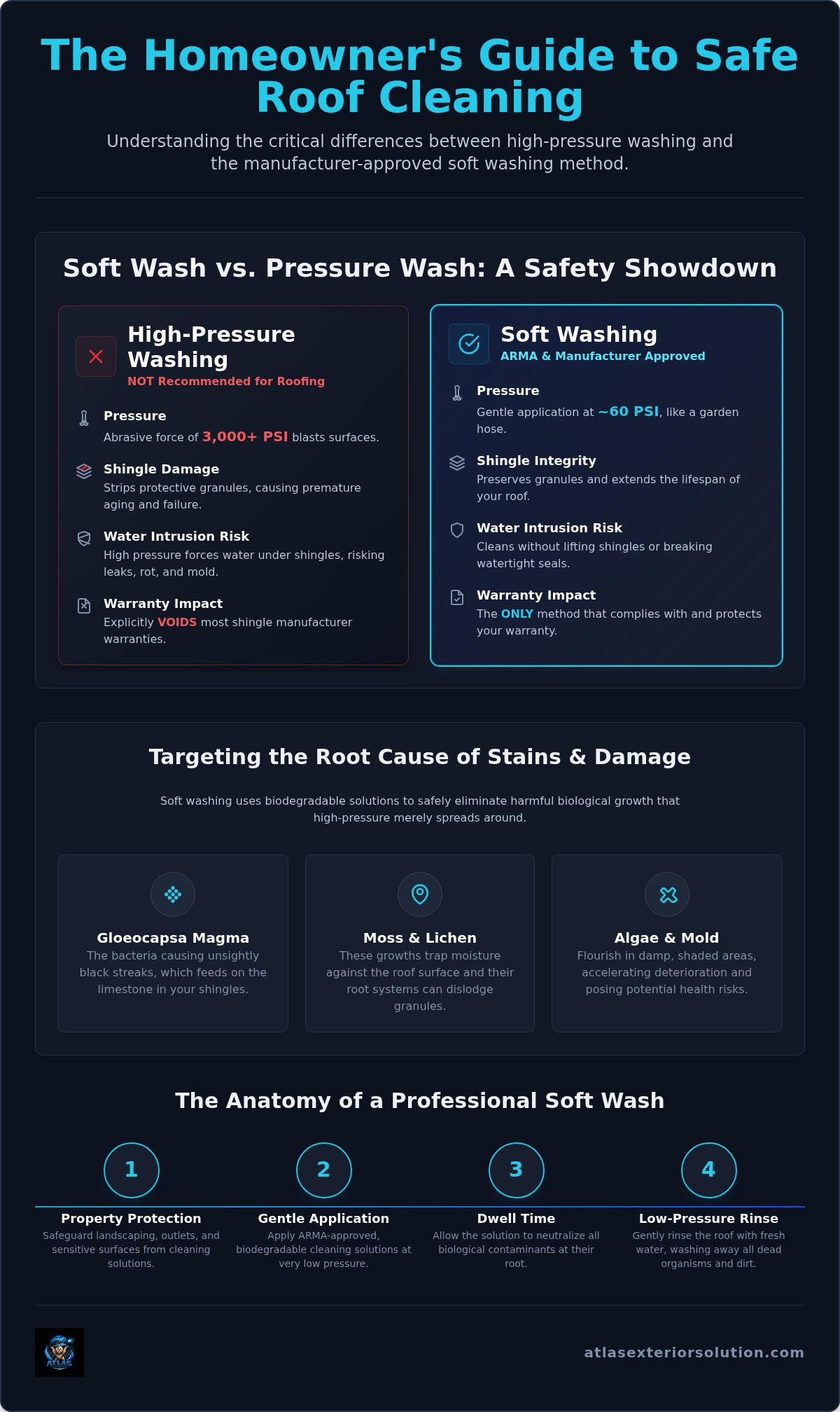
Choosing the right technique for home maintenance often comes down to understanding the physics of the process. Pressure washing relies on sheer mechanical force, typically operating at 3,000 PSI or higher. While this works for dense concrete, it is often catastrophic for roofing materials. Soft washing, by contrast, operates at a gentle 60 PSI. This is essentially the same pressure as a standard garden hose. Instead of using blast force to strip away debris, soft washing uses a specialized chemical decontamination process to dissolve organic growth at its source. It is widely considered the only truly safe roof cleaning method for modern homes.
Another critical difference is operator safety and property risk. Pressure washing often requires technicians to walk on wet, slippery shingles while managing the high-velocity kickback of a spray wand. Soft washing is typically performed from the safety of a ladder or even from the ground. This reduces the risk of falls and prevents the accidental breakage of shingles caused by unnecessary foot traffic. The following breakdown highlights why one approach is superior for residential structures:
- Pressure (PSI): Pressure washing uses ~3,000 PSI; soft washing uses ~60 PSI.
- Cleaning Mechanism: Pressure washing uses mechanical force; soft washing uses chemical decontamination.
- Risk of Damage: Pressure washing carries high risk of granule loss; soft washing is minimal risk.
- Longevity of Results: Pressure washing lasts 6-12 months; soft washing lasts 2-5 years.
Why Soft Washing is the Manufacturer-Approved Method
The Asphalt Roofing Manufacturers Association (ARMA) provides the industry gold standard for shingle care. They explicitly recommend ARMA-approved cleaning methods that utilize specific bleach-based solutions rather than high-pressure water. At Atlas, we follow a Zero-Pressure approach that aligns perfectly with these guidelines. This ensures your warranty remains intact while providing a thorough clean. If you're concerned about the long-term health of your shingles, exploring Professional Roof Cleaning in Bucks County PA is the most reliable way to maintain compliance with manufacturer standards.
The Longevity Factor: Kill the Root, Don't Just Trim the Top
Think of cleaning your roof like dealing with weeds in a garden. Pressure washing is like using a lawnmower; it trims the top of the algae and moss, making the roof look clean for a few months. However, the root structures remain embedded in the shingles, leading to rapid regrowth. Soft washing is like pulling the weed out by the root. The specialized solutions sanitize the entire surface, killing the spores and bacteria that cause black streaks. This results in a roof that stays clean for two to three times longer than traditional methods. While the initial investment might seem similar, the extended interval between cleanings makes soft washing the most cost-effective choice for long-term property preservation. If you want to see the difference for yourself, you can request a consultation for soft washing to protect your home's exterior and ensure a safe roof cleaning method is used on your property.
The Anatomy of a Safe Roof Wash: How the Soft Washing Process Protects Your Home
A professional soft wash is a methodical decontamination process, not a brute-force cleaning session. It follows a strict four-step protocol designed to eliminate organic growth while safeguarding the structural integrity of your property. This approach ensures that every shingle is treated with the care required to maintain its lifespan and warranty compliance. By focusing on chemistry rather than pressure, we provide a safe roof cleaning method that delivers lasting results without the risks of traditional power washing.
The process begins with a comprehensive roof inspection and property protection phase. We identify any existing shingle damage or structural vulnerabilities before work starts. To protect your Bucks County home, we implement a "Meticulous Guardian" strategy. This includes pre-wetting all surrounding landscaping and covering sensitive outdoor furniture to prevent any contact with cleaning solutions. Our team also adheres to 2026 OSHA safety standards, utilizing proper fall protection as mandated by 29 CFR 1926 Subpart M for any roof work at heights of six feet or more.
Biodegradable Solutions and Plant Protection Protocols
We use specialized, biodegradable cleaning solutions that are specifically formulated to target the biofilm living on your roof. These solutions are applied using professional-grade equipment that maintains a low-pressure output similar to a garden hose. Surfactants serve a vital technical purpose by reducing the surface tension of the cleaning solution, allowing it to cling to steep roof pitches for maximum effectiveness. We also utilize neutralizing agents to ensure the entire process is safe for your pets and the delicate ecosystem of your yard. This careful chemical balance is updated to comply with the latest Hazard Communication Standard requirements, ensuring that every technician is trained in the safe handling and application of these materials.
The Role of Dwell Time in Safe Decontamination
Dwell time is the period where the solution sits on the shingles to break down algae and moss at the root level. Scrubbing is never part of a safe roof cleaning method because physical friction can dislodge the protective ceramic granules that provide UV resistance. The solution does the heavy lifting, which preserves the physical integrity of your roof by avoiding the need for abrasive brushes or high-pressure streams. This strategy is supported by the ARMA technical bulletin on safe roof cleaning, which warns that mechanical force can lead to premature roof failure. If you want to understand more about the biology behind those dark stains, you can read our guide on How to Remove Black Streaks from Your Roof Safely.
The final stage involves a low-pressure rinse and a concluding inspection of the shingle health. We ensure that all organic matter has been neutralized and that the runoff is managed according to EPA Clean Water Act regulations. This thoroughness provides the peace of mind that comes from knowing your home’s most valuable asset is clean, protected, and fully restored to its original beauty.
Identifying Roof Contaminants: Why Bucks County Homes Need Targeted Treatment
Bucks County’s high humidity and seasonal temperature swings provide the perfect environment for organic growth to thrive on residential structures. While a "one-size-fits-all" cleaner from a big-box store might promise a quick fix, these products often fail to address the underlying biology of local contaminants. A truly safe roof cleaning method must be tailored to the specific organisms found in the Pennsylvania and New Jersey corridor. Without a targeted approach, you're often just bleaching the surface while leaving the destructive root systems intact.
Modern asphalt shingles are manufactured with limestone filler to provide weight and durability. Unfortunately, this limestone serves as a primary food source for the organic matter that settles on your roof. Over time, this consumption leads to the thinning of your shingles, making them brittle and prone to failure. Professional exterior restoration focuses on neutralizing these pests at the source rather than just rinsing away the visible evidence.
Gloeocapsa Magma: More Than Just an Aesthetic Issue
The black streaks commonly seen on roofs in Newtown and Yardley are actually a hardy cyanobacteria called Gloeocapsa Magma. Beyond the unsightly appearance, these dark stains act as a heat sink. During our humid summers, a darkened roof absorbs significantly more solar radiation, which forces your HVAC system to work harder and drives up your monthly cooling costs. This bacteria spreads quickly between neighboring homes through wind-blown spores, making it a community-wide maintenance challenge. You can learn more about managing these local biological threats in our Moss Removal from Roof Shingles: A Newtown Homeowner Guide.
The Danger of Lichen and Moss Root Systems
Moss and lichen present a more immediate structural threat than bacteria alone. Moss utilizes tiny root-like structures called rhizoids to anchor itself firmly into the ceramic granules of your shingles. Many homeowners make the dangerous DIY mistake of trying to pull moss off by hand or using a stiff brush. This physical force often tears the granules right out of the asphalt, causing permanent damage that cannot be reversed. Lichen is equally problematic because it secretes acids that cause a "pitting" effect, slowly eating away at the roofing material over several seasons. A safe roof cleaning method uses gentle chemistry to detach these organisms without harming the underlying shingle.
Schedule a professional roof inspection today
Choosing a Professional Partner: The Atlas Standard for Exterior Restoration
Selecting the right service provider is just as critical as choosing the method itself. While understanding the technical requirements of a safe roof cleaning method is the first step, the execution requires specialized equipment and a deep sense of accountability. Professional-grade soft washing systems are engineered to deliver precise chemical ratios at consistently low pressures. This is a significant departure from consumer-grade pressure washers, which often lack the fine-tuned controls necessary to prevent accidental shingle damage. At Atlas, we view ourselves as meticulous guardians of your property, ensuring that every application is handled with the precision your home deserves.
Our commitment to the community goes beyond just cleaning surfaces; it's about preserving the long-term health of your estate. We don't just show up to spray a roof. We arrive as knowledgeable consultants who understand the specific environmental challenges of our local area. This dedication to quality ensures that your roof doesn't just look better today, but actually lasts longer because it was treated with the industry's highest standards of care.
Why Local Expertise Matters in Bucks County
Local knowledge is indispensable when dealing with the diverse neighborhoods of our region. Homeowners in areas like Yardley and Richboro often face specific HOA requirements regarding property maintenance and chemical usage. We understand these local nuances and tailor our approach to meet both community standards and manufacturer guidelines. Our familiarity with Pennsylvania weather patterns allows us to anticipate when organic growth is most likely to accelerate, helping you stay ahead of potential damage. Choosing Professional Soft Washing Services means partnering with a team that is already invested in the beauty and resilience of your neighborhood.
Peace of Mind Through Full Insurance and Expert Training
Roof work is inherently high-risk, and hiring an uninsured or under-trained contractor can lead to significant liability for a homeowner. If a technician without proper coverage suffers an injury or causes structural damage, you could be held financially responsible. Atlas removes this worry by maintaining full insurance and adhering to rigorous safety protocols. Our technicians are trained in the latest 2026 OSHA standards, ensuring that every job is performed safely and legally. We provide restorative results without the risk of damage, giving you the confidence that your most valuable asset is in expert hands. It's about more than a clean roof; it's about the peace of mind that comes from a job done right by a safe roof cleaning method specialist.
Request your free roof cleaning estimate from Atlas Exterior Solutions
Protecting Your Investment with Professional Care
Your roof is more than just a covering; it's a vital shield for your family and your most valuable asset. We've highlighted how shifting from force-based cleaning to a safe roof cleaning method like soft washing prevents structural damage and protects your manufacturer warranty. This professional approach ensures that delicate asphalt shingles are cleaned without the destructive impact of high-pressure water. By using manufacturer-approved techniques, you're investing in the long-term health of your home rather than just a temporary aesthetic fix.
As a fully insured, locally owned specialist, Atlas Exterior Solutions LLC provides the meticulous care required to manage Bucks County's unique climate challenges. We understand the pride of ownership you feel, and we share that dedication through our transparent, detail-oriented service. Our team combines professional-grade equipment with expert training to ensure your property remains a source of pride for years to come. We're committed to being your dependable partner in exterior preservation, offering the expertise needed to navigate the specific environmental needs of areas like Newtown and Yardley.
Protect your roof with a professional soft wash estimate from Atlas Exterior Solutions LLC
We look forward to helping you restore your home's beauty and ensuring your roof stays in peak condition for years to come.
Frequently Asked Questions
Is soft washing safe for my plants and landscaping?
Yes, soft washing is completely safe for your landscaping when performed by a professional following strict protection protocols. We utilize a "Meticulous Guardian" approach that includes pre-wetting all foliage and rinsing plants throughout the process to dilute any runoff. Our specialized neutralizing agents ensure that your prized Bucks County gardens remain healthy and vibrant while your roof receives a deep, restorative clean.
How often should I have my roof cleaned using the soft wash method?
Most homeowners should schedule a professional cleaning every three to five years to maintain optimal shingle health. The exact frequency depends on your property's environment, such as the amount of shade from overhanging trees and local humidity levels. Regular maintenance using this safe roof cleaning method prevents organic growth from becoming deeply rooted, which helps preserve the structural integrity of your asphalt shingles over time.
Will roof cleaning void my shingles' manufacturer warranty?
Roof cleaning will not void your warranty as long as you use the soft wash method recommended by the Asphalt Roofing Manufacturers Association (ARMA). In fact, most major manufacturers like GAF and Owens Corning explicitly require low-pressure chemical cleaning for their products. Problems only arise when high-pressure power washing is used, as the mechanical force can cause permanent damage that immediately voids your protection.
Can I clean my roof myself using a safe method?
DIY roof cleaning is generally discouraged due to significant safety risks and the complexity of chemical handling. Professionals use specialized equipment to maintain precise chemical ratios that aren't available in consumer-grade sprayers. Additionally, walking on a wet, soapy roof is extremely dangerous without OSHA-mandated fall protection. Hiring an insured expert ensures the job is done correctly without risking your personal safety or property damage.
What are the black streaks on my roof, and are they dangerous?
The black streaks are caused by Gloeocapsa Magma, a hardy cyanobacteria that feeds on the limestone filler in modern shingles. While these streaks aren't directly dangerous to humans, they're destructive to your roof's lifespan. This bacteria thins the shingles and increases solar heat absorption, which leads to higher cooling costs. Treating these streaks promptly prevents the bacteria from spreading and causing premature roof failure.
How long does a professional soft wash treatment last?
A professional soft wash treatment typically keeps a roof clean for two to five years, which is significantly longer than traditional pressure washing. Because the process sanitizes the surface and kills the root structures of algae and moss, regrowth is much slower. This longevity makes it a highly cost-effective solution for homeowners who want to maintain their curb appeal without the need for annual cleaning sessions.
Does soft washing work on metal or tile roofs as well?
Soft washing is highly effective and safe for metal, tile, slate, and cedar shake roofs. Each material requires a slightly different chemical concentration and application technique to ensure the surface isn't etched or corroded. By adjusting the solution to fit the specific needs of the material, we can remove oxidation from metal or biological growth from tile without using any damaging high-pressure water.
What is the difference between power washing and soft washing?
The primary difference is the reliance on pressure versus chemistry to achieve a clean surface. Power washing uses mechanical force, often exceeding 3,000 PSI, which can easily strip away protective shingle granules. Soft washing is the only truly safe roof cleaning method because it uses high-volume, low-pressure water at about 60 PSI. This approach relies on specialized, biodegradable solutions to dissolve contaminants rather than blasting them away.
Disclaimer
The information on this blog is for general informational purposes only. Results may vary based on surface type, condition, and cleaning methods. Always follow manufacturer guidelines and use proper safety precautions. Atlas Exterior Solutions is not liable for any damages or losses resulting from the use of this information.


