

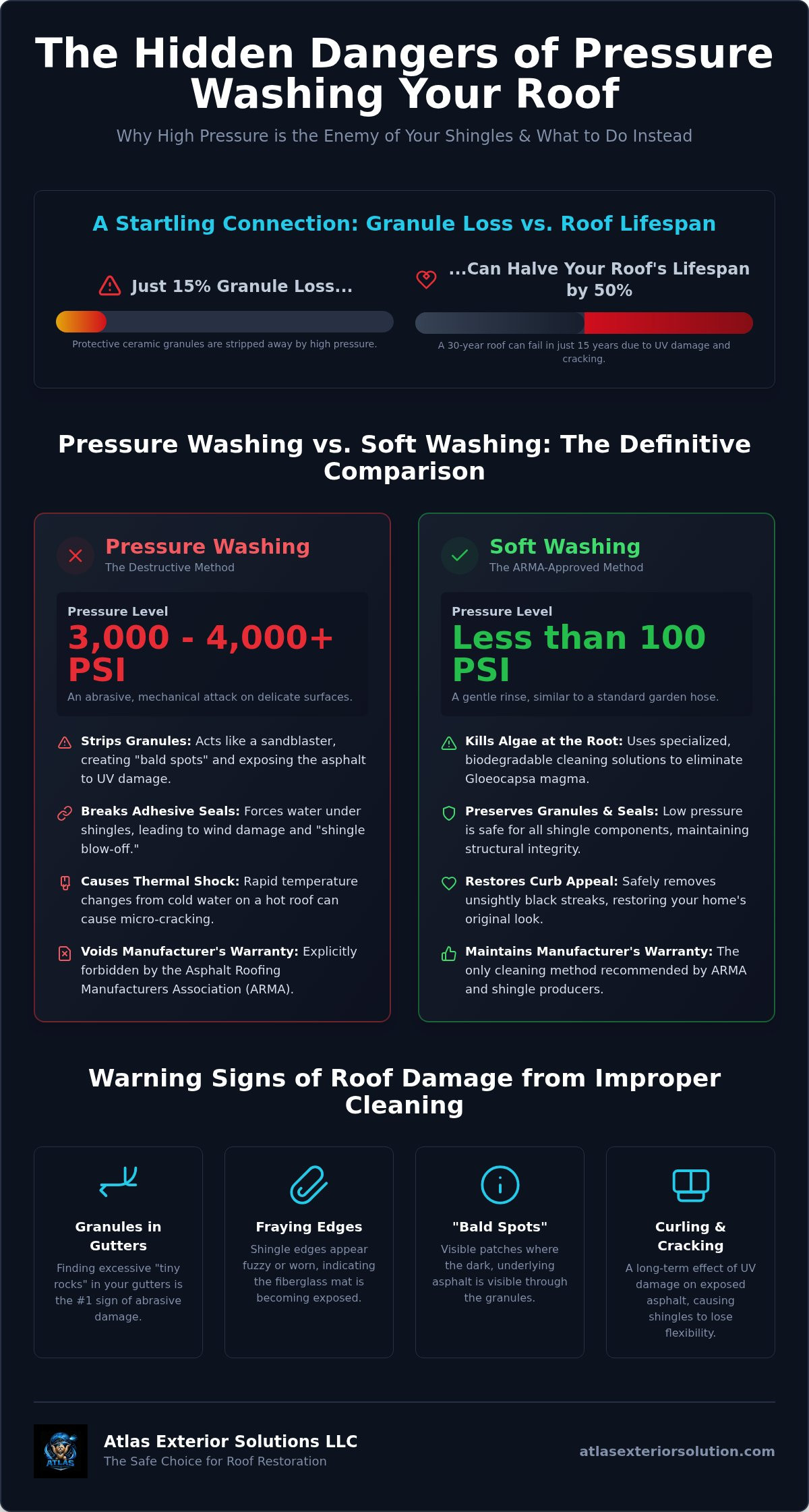
Losing just 15% of your roof's protective ceramic granules can slash its effective lifespan by 50%. It is a startling statistic that highlights why many homeowners feel a sense of dread when they spot those unsightly black streaks known as Gloeocapsa magma. You want your home to look its best, but you also want to avoid a costly mistake. One of the most common questions we hear from homeowners in Bucks County is, does pressure washing damage shingles? The short answer is yes, because 4,000 PSI of water is a mechanical attack on a delicate surface that requires a much gentler touch.
We understand the frustration of receiving conflicting advice from neighbors while worrying about voiding your manufacturer’s warranty. This article will show you why high pressure is the enemy of your roof and introduce the professional soft wash alternative. You will discover how this low pressure technique, which is the only method approved by the Asphalt Roofing Manufacturers Association, preserves your shingles while restoring your home’s curb appeal. We are going to walk through the science of safe cleaning and explain how to protect your landscaping while achieving a roof that looks brand new.
Key Takeaways
- Learn why the Asphalt Roofing Manufacturers Association (ARMA) forbids high-pressure cleaning to prevent premature material failure.
- Understand the mechanical risks and find the definitive answer to does pressure washing damage shingles by examining how high PSI acts as an abrasive against asphalt surfaces.
- Discover the soft wash method, which uses less than 100 PSI to safely eliminate algae at the root while preserving your roof's structural integrity.
- Spot the smoking gun signs of roof damage. These include excessive granule loss in your gutters and visible fraying along shingle edges.
- See how a specialized local approach protects your Bucks County property. Our meticulous process is designed to balance effective cleaning with total landscape safety.
The Short Answer: Yes, Pressure Washing Can Destroy Your Roof Shingles
High pressure is the leading cause of premature roof failure during the cleaning process. While it's tempting to grab a rental unit to blast away stains, the Asphalt Roofing Manufacturers Association (ARMA) specifically forbids high-pressure cleaning on asphalt surfaces. They recognize that shingles are not designed to withstand the concentrated force of a pressure washer. Instead, they recommend Soft washing as the only safe and effective method for removing organic growth. If you ignore these guidelines, you risk voiding your 30-year manufacturer warranty in a single afternoon. Most major shingle producers explicitly exclude coverage for damage caused by high-pressure equipment. Roof pressure damage is defined as the mechanical stripping of protective asphalt granules from the shingle surface.
The Immediate Impact: Granule Loss and UV Protection
Many homeowners ask, does pressure washing damage shingles? The answer becomes clear when you look at your gutters. Those "tiny rocks" you find after a heavy rain or a cleaning session are ceramic-coated granules. They aren't just there for color; they are your roof's primary defense against the elements. These granules reflect UV rays and provide essential fire resistance. When high-pressure water hits the shingle, it acts like a sandblaster, creating "bald spots" where the raw asphalt is exposed. These areas absorb heat much faster than the rest of the roof. In the intense Pennsylvania sun, this localized heat leads to shingle curling and cracking, which can reduce your roof's effective lifespan by as much as 50% if you lose just 15% of that protective layer.
Compromising the Seal and Adhesive Strips
Shingles are engineered to shed water that flows naturally downward with gravity. They aren't built to handle a high-velocity stream of water directed upward or from the side. High-pressure water easily forces its way underneath the shingle edges, which can snap the factory-applied adhesive bond that keeps your roof watertight. This breakage is a serious concern for homeowners in Bucks County, where seasonal windstorms are common. Once that seal is broken, you face a significantly higher risk of "shingle blow-off" during high winds. Beyond the physical loss of shingles, this water intrusion can lead to mold growth in your attic or structural rot that remains hidden until it's too late. Choosing Residential Soft Washing and Roof Cleaning is the only way to ensure your home remains protected by using specialized solutions rather than destructive force to achieve a clean result.
The Mechanics of Damage: What Happens Under 3,000 PSI?
When homeowners ask, does pressure washing damage shingles, they are often focused on the visible results, but the true danger lies in the physics of the process. To understand the risk, you have to distinguish between Pounds per Square Inch (PSI) and Gallons per Minute (GPM). While flow (GPM) is generally safe, high pressure (PSI) is a destructive force. Most standard pressure washers operate at 3,000 to 4,000 PSI, which is far too aggressive for asphalt. This mechanical force explains why the answer to does pressure washing damage shingles is always a definitive yes. The Asphalt Roofing Manufacturers Association (ARMA) explicitly warns that this level of force can strip away the protective qualities of your roof in minutes.
Using a high-pressure wand on a roof creates a "sandblasting" effect. Asphalt shingles are essentially flexible mats coated in petroleum and ceramic granules. The high-velocity water acts as an abrasive, scouring these granules away and leaving the underlying asphalt exposed to the elements. Another often-overlooked factor is thermal shock. On a hot July afternoon in Newtown, your roof surface can easily reach 150 degrees. When cold water from a high-pressure hose hits that scorching surface, the rapid temperature change causes the shingle materials to contract violently, leading to micro-cracks and structural stress. The concentrated stream of a pressure washer creates a lifting effect that forces water upward and under the shingle laps, directly saturating the wooden roof deck and underlayment.
Water Intrusion and Mold Growth
High pressure does more than just damage the surface; it compromises the watertight integrity of your home. The force of the water pushes moisture deep into the soffits and behind the fascia boards where it cannot easily evaporate. This trapped moisture creates a breeding ground for attic mold, a hidden danger that many homeowners don't discover until a professional inspection. Because the water is forced in at such high velocity, standard drying times are insufficient to prevent structural rot. If you want to avoid these mechanical risks, choosing a professional soft wash roof cleaning is the safest way to restore your home.
Etching and Aesthetic Damage
The visual consequences of improper cleaning are often permanent. Inconsistent pressure application leaves behind "wand marks," which look like light-colored scars or stripes across the shingles where granules were unevenly removed. These marks cannot be fixed without replacing the shingles entirely. Furthermore, pressure washing often fails to kill the root of the algae, leaving behind microscopic spores. This results in a "clean" look that only lasts a few months before the black streaks return in uneven patterns. There is a massive difference between a surface that has been blasted clean and one that has been scientifically restored to its original condition.
Soft Washing vs. Pressure Washing: Which is the Safe Method?
While the previous sections detailed the mechanical risks of high-pressure water, soft washing offers a scientific alternative that prioritizes the longevity of your home. Many homeowners ask, does pressure washing damage shingles more than a chemical treatment? The reality is that Soft Washing isn't just a different technique; it's an entirely different philosophy. It utilizes low-pressure application, typically operating at under 100 PSI, which is roughly the same force as a standard garden hose. Instead of relying on raw power to blast away debris, this method uses specialized chemical pumps to apply a tailored cleaning solution that does the heavy lifting without the risk of shingle abrasion.
This approach shifts the focus from a mechanical "scrubbing" to a biological treatment. We don't view those black streaks as mere dirt. They are living organisms, specifically a type of cyanobacteria that feeds on the limestone filler in your shingles. Treating this growth like a pest infestation rather than a surface stain ensures that the problem is solved at the source. Following the Asphalt Roofing Manufacturers Association guidelines, we use this low-pressure method to ensure the roof is sanitized without ever compromising its structural integrity.
The Soft Wash Chemical Arsenal
The success of this method relies on a precise blend of sodium hypochlorite and professional-grade surfactants. The sodium hypochlorite acts as the active agent that kills Gloeocapsa magma and moss spores at the root, while the surfactants allow the solution to "cling" to the steep pitches of a roof for maximum contact time. Killing these organisms is the only way to prevent the immediate return of black streaks. Because we are a meticulous guardian of your property, we also incorporate neutralizing agents. These are essential for protecting the delicate landscaping and pets common in our Bucks County neighborhoods, ensuring that the only thing affected by the treatment is the organic growth on your roof.
Why Professionals Choose Soft Washing
Professional cleaners prefer soft washing because it is both more efficient and significantly safer for the technician and the structure. By using specialized equipment, we can often clean the roof from the gutter line or a ladder, which minimizes the need to walk on fragile, sun-baked shingles. This method also reaches deep into the pores of the shingle surface where high pressure simply cannot penetrate. Beyond the immediate visual results, the long-term cost savings are substantial. Because soft washing actually kills the spores rather than just moving them around, the results typically last two to three times longer than a standard pressure wash, providing better value and peace of mind for the homeowner.
Warning Signs: Identifying Roof Damage from Improper Cleaning
Many homeowners walk away from a DIY project wondering, does pressure washing damage shingles, only to find the evidence weeks later in their landscaping or gutters. Damage from high pressure is not always immediately visible from the ground, but the warning signs are unmistakable once you know where to look. The most obvious "smoking gun" is a heavy accumulation of granules in your gutters. While some granule loss is expected over the natural life of the roof, a sudden influx after a cleaning session indicates that the protective ceramic layer has been mechanically stripped away. This loss of material leaves your home vulnerable to UV rays and premature aging.
Visible abrasion is another key indicator that the cleaning method was too aggressive. If you look closely at the shingle tabs, you may see frayed or "fuzzy" shingle edges. This texture is a sign of mechanical abrasion where the high-pressure stream has literally torn the asphalt fibers. Additionally, you should check your attic for water spots on the ceilings. High pressure can force water into the soffits or under the underlayment, leading to hidden moisture issues that standard rain would never cause. If you are seeing these signs, the answer to does pressure washing damage shingles is a clear yes, and the integrity of your roof may already be compromised.
How to Audit a Pressure Washing Quote
When you are looking for a professional to treat your home, you can spot potential risks before the work begins by auditing the estimate. Listen for red flag phrases like "we use high-pressure tips for tough stains" or "pressure washing the roof." These statements are clear indicators that the contractor does not understand the delicate nature of asphalt surfaces. Instead, ask specifically about their cleaning PSI and if they follow ARMA guidelines. A reputable local provider will be transparent about their low-pressure methods and the equipment they use. For residents in Newtown and Yardley, choosing a fully insured company like Atlas Exterior Solutions ensures that your home is in the hands of a meticulous guardian. If you want to protect your investment, schedule a safe roof cleaning with our expert team today.
Assessing Algae and Moss Regrowth
High pressure often makes a biological problem worse in the long run. Moss has "roots" called rhizoids that anchor deep into the shingle. Blasting the surface might remove the green visible parts, but it leaves the rhizoids behind and pits the shingle surface. This creates a cycle of damage: the pitting holds more moisture, which encourages even more moss to grow back faster than before. You can identify the difference between dead and dormant algae by the color after a treatment. Dead algae will turn a light gray or white and eventually wash away with rain, while dormant algae remains dark and ready to thrive as soon as the next storm arrives. A safe soft wash ensures the growth is dead, not just dormant.
Professional Roof Restoration in Bucks County: The Atlas Way
When you ask, does pressure washing damage shingles, you aren't just looking for a technical answer; you're looking for a way to protect your home. Since our inception, Atlas Exterior Solutions LLC has served the Newtown and Yardley areas with a commitment to quality that goes beyond a simple cleaning service. We operate as a "Meticulous Guardian" for your property, recognizing that your roof is the most valuable asset protecting your family. While we've established that the answer to does pressure washing damage shingles is a resounding yes, we provide the safe, soft wash alternative that preserves your shingles and maintains your warranty. Our team is fully insured and deeply familiar with the specific architectural styles and roofing materials found throughout Bucks County.
Our approach is rooted in transparency and local reliability. We understand that homeowners often face conflicting advice, which is why we prioritize an educational process. We walk you through the "how" and "why" of our soft washing method, showing you exactly how we kill organic growth without the destructive force of a high-pressure wand. This dedication to detail is why local homeowners trust us to handle their most delicate exterior surfaces. By choosing a professional who understands the science of the materials, you gain peace of mind and pride of ownership in a home that looks truly renewed.
Serving Our Bucks County Neighbors
The Delaware Valley presents unique environmental challenges that contribute to rapid roof staining. The high humidity levels in neighborhoods like Richboro and Langhorne create the perfect breeding ground for algae and moss. This isn't just an aesthetic issue; it's a structural threat that requires a professional touch tailored to our local climate. We don't just stop at the roofline. To provide a total exterior refresh, we coordinate our specialized roof treatments with professional house washing and thorough gutter cleaning. This holistic approach ensures that every surface of your home is treated with the appropriate level of care, using specialized techniques that provide a deep clean without the risk of high-pressure damage.
Ready for a Like-New Roof?
Choosing Atlas means choosing a long-term solution rather than a temporary fix. Our ARMA-approved soft washing process delivers results that can extend the life of your shingles by a decade or more while keeping your manufacturer warranty intact. We are dedicated to 100% customer satisfaction, ensuring that your property is left in better condition than we found it. If you're ready to restore the beauty of your home in Newtown or Bensalem, the process is simple and transparent. You can regain that curb appeal without the fear of mechanical damage or landscape loss. Get Your Free Roof Cleaning Estimate from Atlas Exterior Solutions and let us show you the professional difference of a meticulous, local approach.
Take Control of Your Home’s Longevity
Your roof is the first line of defense for your property, and maintaining its integrity requires a specialized approach that respects the limits of asphalt materials. We have explored the clear answer to the question, does pressure washing damage shingles, by detailing the mechanical risks of high-pressure water and the resulting loss of protective granules. By choosing a biological treatment over a mechanical attack, you ensure that algae is eliminated at the root without compromising the structural seal of your shingles. This methodical approach protects both your home’s appearance and its long-term value.
As a locally owned and fully insured provider, Atlas Exterior Solutions LLC is proud to offer a 5-star rated service that utilizes the ARMA-approved soft wash method. We take pride in being the meticulous guardian of properties throughout Bucks County, providing a total exterior refresh that preserves your manufacturer warranty. You don't have to choose between a clean roof and a safe one. Our team is ready to deliver the expert results and peace of mind you deserve.
Protect Your Roof with Professional Soft Washing from Atlas Exterior Solutions LLC
We look forward to helping you restore your home's curb appeal with the local expertise and care it deserves.
Frequently Asked Questions
Is soft washing the same as using a garden hose?
Soft washing is significantly more effective than using a standard garden hose. While the pressure levels are similar, professional soft washing relies on a precise blend of surfactants and algaecides to kill organic growth at the source. A garden hose only rinses the surface and won't eliminate the underlying bacteria. Our specialized pumps ensure the solution is applied evenly to reach deep into the shingle texture without any mechanical force.
Will the cleaning chemicals damage my plants or lawn?
Professional soft washing includes strict protocols to safeguard your landscaping. We protect your greenery by pre-wetting all foliage and applying a neutralizing agent to the soil and leaves. This process ensures that the cleaning solutions only affect the organic growth on your roof. Our meticulous approach allows us to restore your shingles while keeping your flowers and lawn perfectly healthy throughout the service.
How often should I have my roof professionally cleaned in Bucks County?
Most homes in the Bucks County area require a professional roof cleaning every two to three years. The humid climate in the Delaware Valley encourages the rapid return of algae spores. If your property is heavily shaded or surrounded by mature trees, you might benefit from an annual inspection. Regular maintenance prevents the algae from feeding on your shingles' limestone filler and extending the life of your roof.
Can pressure washing a roof cause leaks inside my house?
Yes, high pressure can cause internal leaks by forcing water upward under the shingle laps. This is a primary reason why homeowners ask, does pressure washing damage shingles, as the force can bypass the roof's natural shedding design. Soft washing avoids this risk entirely by using low pressure that flows downward with gravity. This protects your attic and insulation from moisture intrusion while the cleaning agents do the work.
Does roof cleaning remove the black streaks permanently?
No roof cleaning method can remove black streaks permanently because algae spores are airborne and ever-present in the environment. However, soft washing kills the growth at the root, which keeps your roof clean for two to three times longer than pressure washing. By sanitizing the surface, we reset the biological clock of your roof. Periodic maintenance is the best way to ensure those unsightly streaks don't return to ruin your home's curb appeal.
Will cleaning my roof void the shingles manufacturer warranty?
High-pressure cleaning will likely void your shingle manufacturer warranty. Most major producers explicitly state that shingles should only be cleaned using the soft wash method. Using a pressure washer is considered mechanical abuse rather than standard maintenance. By following approved techniques, we help you maintain your warranty coverage while ensuring the answer to does pressure washing damage shingles remains a concern of the past.
Is it safe to walk on shingles while they are being cleaned?
It is generally best to avoid walking on shingles during the cleaning process. Shingles become slippery when wet and can be easily damaged when they are hot and sun-baked. Our professional team uses specialized long-range nozzles and ladder systems to clean most roofs from the gutter line. This approach minimizes foot traffic, which prevents mechanical damage to the shingle tabs and ensures the safety of our technicians.
How long does a professional soft wash roof cleaning take?
A professional soft wash roof cleaning typically takes between two and five hours to complete. This timeframe varies based on the total square footage of the roof, the steepness of the pitch, and the severity of the algae infestation. We take the necessary time to ensure every shingle is properly treated and that all surrounding landscaping is protected. You can expect a complete transformation of your home's exterior in a single afternoon.
Disclaimer
The information on this blog is for general informational purposes only. Results may vary based on surface type, condition, and cleaning methods. Always follow manufacturer guidelines and use proper safety precautions. Atlas Exterior Solutions is not liable for any damages or losses resulting from the use of this information.


