

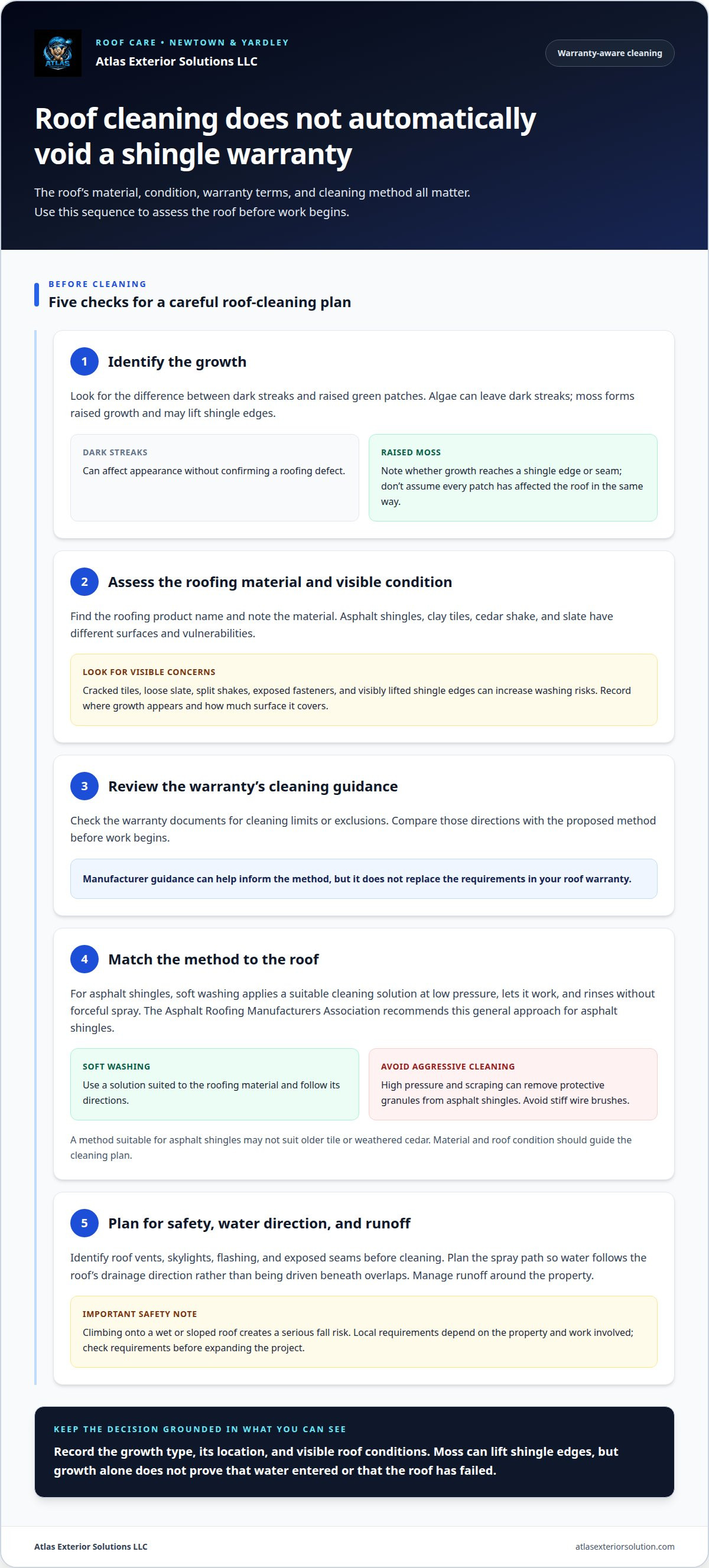
Roof cleaning does not automatically void a shingle warranty; the warranty terms and cleaning method matter. For roof moss removal in Newtown and Yardley, Atlas Exterior Solutions LLC prioritizes addressing growth without scraping away granules or directing force at vulnerable shingles. Moss can lift shingle edges, while algae can leave dark streaks, so consider the roof’s condition before cleaning.
It’s understandable to want a clean roof without risking damage or warranty coverage. A sound decision starts with identifying what is growing, assessing the shingles, and reviewing the warranty’s cleaning guidance. This guide explains how moss and algae affect roofing, why high-pressure washing and aggressive scrubbing can create avoidable risks, and how soft washing differs from pressure washing. It also covers how a roof assessment can shape the cleaning approach and which warranty details to review before work begins.
Key Takeaways
- Shingle warranty coverage depends on its terms and the cleaning method, so review the manufacturer’s care guidance before work begins.
- Moss can lift shingle edges, while algae can leave dark streaks; identifying the growth helps guide the cleaning approach.
- Soft washing applies a cleaning solution with low pressure, unlike pressure washing, which can cause damage when used on delicate roofing.
- Roof material, slope, shade, and canopy affect how an assessment should guide cleaning and help reduce washing risks.
- Cleaning intervals vary by exposure: open-sun roofs may need attention every three to five years, while north-facing slopes under mature canopy may need it every two to three years.
Will roof cleaning void my shingle warranty?
Roof cleaning does not automatically void a shingle warranty; the method and warranty terms matter. If you’re considering roof moss removal in Newtown, first find the roofing product name and its care instructions. Warranty documents may set cleaning limits or exclusions, so compare those directions with the proposed method. Don’t assume one approach suits every roof: asphalt shingles, clay tiles, cedar shake, and slate have different surfaces and vulnerabilities.
On asphalt shingles, avoid aggressive pressure and scraping that can remove protective granules. Soft washing applies an appropriate cleaning solution at low pressure, lets it work, and rinses without forceful spray. The Asphalt Roofing Manufacturers Association recommends this general approach for asphalt shingles, but that guidance does not replace your roof warranty. Follow any cleaning restrictions in the warranty documents.
Clay tiles, cedar shake, and slate need material-specific care. A method suitable for asphalt shingles may not suit an older tile roof or weathered cedar. Before applying water or cleaning solution, look for cracked tiles, loose slate, split shakes, and exposed fasteners. These conditions can increase washing risks, regardless of the growth being removed. The roof’s material and condition should shape the cleaning plan.
Use a solution suitable for the roofing material, follow its directions, and manage runoff around the property.
Are permits or local rules required for roof cleaning in Newtown? Requirements depend on the property and the work involved. Treat routine washing separately from roof repairs or structural changes, and check local requirements before expanding the project.
Can homeowners remove roof moss themselves? Although it may be possible, climbing onto a wet or sloped roof creates a serious fall risk. Avoid pressure washers and stiff wire brushes, and follow product directions and warranty guidance. To reduce moss regrowth, remove debris that holds moisture and address shade where practical.
Does homeowners insurance cover moss removal or related damage? Policy wording and the documented cause determine how a claim is handled. Review maintenance and accidental-damage terms before work, and keep photos of existing roof conditions. Moss can hold moisture and lift shingle edges, so timely, careful cleaning may help limit deterioration. It cannot repair existing roof damage or replace warranty requirements.
Algae and moss effects on roofing
Across Newtown and Bucks County, roof growth can affect a home’s appearance in different ways. Dark streaks may run down asphalt shingles, while moss appears in raised green patches. These patterns can help distinguish types of buildup from a distance. The difference matters because a broad stain and a concentrated moss patch present different cleaning challenges.
Black streaks on asphalt shingles can be caused by Gloeocapsa magma, a cyanobacterium that feeds on limestone filler in modern shingles. The streaks may follow water runoff and make otherwise sound shingles look aged. Appearance alone does not establish the roof’s physical condition, so don’t mistake staining for a confirmed roofing defect.
Moss is more visible as a raised layer, especially where it gathers on shaded roof sections. It can make the surface look irregular and conceal details beneath the growth. During a visual review, note where each patch begins and ends rather than treating the whole roof as equally affected.
Compare affected areas with nearby sections that look clear. Dark marks limited to one slope, for instance, differ from streaking across several slopes. Similarly, a small moss patch is not the same as growth covering a broad area. These distinctions help describe the roof and identify where closer attention may be useful.
Organic growth can complicate a visual inspection. A dense patch may hide the shingle color and make nearby surface details harder to see. Record exposed edges, changes in appearance, and debris around the patch separately. This creates a clearer account of what is visible without treating growth itself as proof of roof failure.
For a roof in the Newtown area, note the growth type, location, and how much surface it covers. These observations are more useful than simply describing the roof as “dirty.” A precise record can guide the next assessment and focus attention on affected areas rather than prompting unnecessary work across the whole roof.
Moss deserves attention not just because it changes the roof’s appearance, but because of where it grows. It can root between shingle seams and lift their edges, allowing wind-driven rain beneath the shingle course. A raised patch near a seam is a reason to look more closely, but it does not prove that water has entered or that the roof has failed. Record the location and visible extent of the growth when describing the roof.
When documenting moss, distinguish growth resting on the surface from growth that appears to reach a shingle edge or seam. Record visibly lifted edges separately, and don’t assume every patch has affected the shingles in the same way. This focused description can direct attention to the relevant section during a closer assessment. Moss may create a route for wind-driven rain beneath a shingle course, but describe the evidence you can see rather than claiming an unconfirmed outcome.
Reducing the risk of damage from high-pressure washing
Roof-washing risk depends on more than equipment settings. Water directed toward roof vents, skylights, flashing, or exposed seams can enter vulnerable details. Before work begins, identify these features and plan the spray path so water follows the roof’s drainage direction rather than being driven beneath overlaps.
Roof layout affects runoff. Valleys concentrate water, while gutters and downspouts carry it away from the roof edge. Note blocked drainage points, loose gutter sections, and areas where runoff could spill onto sensitive exterior surfaces. Managing these routes helps limit pooling and prevent cleaning solution from collecting where it is not wanted.
Choose an application to suit the roofing material and its visible condition. A professional low-volume soft-washing process from Atlas Exterior Solutions LLC uses a suitable cleaning solution to address organic growth without relying on force. Follow the solution’s directions for preparation, application, and rinsing. Don’t improvise its concentration or contact time; the product instructions and roof material determine appropriate handling.
Nearby property needs attention too. Identify exterior fixtures and walkways below the roof, and note siding, windows, and other surfaces that runoff could reach. Protect vulnerable areas before treatment and manage where runoff travels. Keep doors and windows closed where spray or runoff could reach the house.
Weather and roof condition affect the work sequence. A wet or slippery surface increases the danger of roof access, while wind can carry spray beyond the intended area. Postpone work when conditions make controlled application difficult. Record loose flashing, open seams, or damaged roof details before cleaning, since washing cannot correct those defects.
During treatment, position equipment and hoses to avoid dragging them across roof edges or striking fixtures. Apply solution in manageable sections, monitor runoff, and pause if water behaves unexpectedly near a vent or valley. A controlled pace makes it easier to spot drainage problems before they affect siding, windows, or the ground below.
After cleaning, check visible roof details and drainage points from a safe location. Look for displaced components, pooled water, or runoff marks around gutters and downspouts, then compare them with your pre-cleaning notes. This record helps distinguish existing issues from changes noticed after washing and provides a useful reference point for future roof maintenance.
Low-pressure soft washing is an ideal method for safe roof moss removal in Newtown Square, eliminating algae, moss, and lichen effectively. No-pressure soft washing applies a solution at low volume, allows it to work, and rinses it thoroughly. These approaches keep the cleaning process focused on the solution rather than destructive force. Scrubbing roof moss can damage the roof and knock off protective granules, so Atlas Exterior Solutions LLC always avoids treating manual abrasion as a substitute for controlled application.
Roof and slope assessment
A useful roof assessment records where growth appears, the material covering each slope, and any visible damage. On a Yardley home, a north-facing slope may remain shaded longer than a south-facing one. Mapping those differences helps distinguish isolated buildup from a broader moisture pattern and informs a suitable cleaning plan.
Start by noting slope direction and nearby shade. A roof beneath mature trees may get less sun and collect leaves, while an open slope dries more readily. Record overhanging branches, shaded valleys, and areas where debris gathers. These details help explain why moss may cluster on one roof section rather than appear evenly across the surface.
Next, identify the roofing material and visible growth. Asphalt shingles, slate, clay tiles, and cedar shake have different surfaces and edges. Note whether the growth appears as black streaks, raised moss patches, or lichen. A photo taken from the ground can record its location without requiring you to climb onto the roof.
Check the roof’s drainage paths from a safe vantage point. Valleys, roof edges, and gutters can show where leaves or moss collect and where water flows. Look for overflowing gutters, debris at downspouts, and damp-looking areas beneath roof edges. A blocked drainage path may keep nearby roofing wet longer and affect where growth persists.
Visible roof condition also affects the cleaning decision. Look for lifted shingle edges, missing granules, cracked tiles, loose slate, split cedar, and damaged flashing. These conditions can signal vulnerabilities that need attention before washing. Record each concern separately from algae or moss, since surface growth and physical roof damage are different issues.
Use the assessment to set cleaning boundaries. Mark areas with heavy moss, delicate materials, and visible damage, then match treatment to each surface. Sound asphalt shingles may call for a different approach from cracked clay tiles or weathered cedar. Don’t apply one pressure level or solution across dissimilar materials.
- Map exposure: note north-facing slopes, tree shade, and open areas.
- Identify materials: record shingles, slate, tile, or cedar shake.
- Locate buildup: mark moss, algae streaks, lichen, and debris.
- Record concerns: note lifted edges, cracks, and drainage issues.
These notes provide a clearer basis for deciding whether cleaning is appropriate across the roof or only on certain slopes. For roof moss removal in Yardley, let the material, growth, exposure, and condition guide the plan. If you take photos from the ground, compare the same slopes later to track changes without walking on the roof.
How often should roofs in Newtown be inspected or treated for moss?
Cleaning intervals depend on sun exposure and tree cover. For roofs in open sun, the recommended cleaning interval is three to five years. A north-facing slope beneath mature canopy may need cleaning every two to three years. Treat these intervals as starting points, not a reason to wash a roof without buildup or when it needs repair.
Inspection and cleaning are separate decisions. You can check a roof for visible growth without automatically scheduling a wash. From the ground, look for new green patches, dark streaks, debris in valleys, or growth along shaded edges. Compare these areas with previous observations to see whether moss is spreading or a new stain has appeared.
Shade affects how quickly individual slopes dry. A north-facing section under mature trees may hold moisture longer than an open, sunlit slope. This helps explain why one side may need attention sooner. Consider tree cover and growth patterns together rather than applying the sun-exposure interval to every part of the roof.
Heavy moss may need a second cleaning visit the following season. This gives the first treatment time to work before another assessment determines whether substantial growth remains. Don’t force stubborn moss off between visits by scraping or using high-pressure spray. A follow-up should account for remaining growth, roof material, and visible damage.
After cleaning, record the date, affected slopes, and visible condition. Photos taken safely from the ground can help you compare changes over time. Note whether the roof is open to sun or shaded by mature trees. These details make future inspections more useful and help distinguish normal discoloration from renewed moss growth.
Use these cues to plan your next inspection:
- Open-sun roof: use the three-to-five-year cleaning interval as a guide.
- North-facing slope under mature canopy: use the two-to-three-year interval.
- Heavy moss after treatment: reassess during the following season.
- New visible growth or roof damage: arrange an assessment rather than waiting for a routine interval.
Consistent records help you notice changing conditions before buildup becomes extensive. For Newtown roofs, match the cleaning schedule to each slope’s exposure, tree cover, and actual moss growth. A heavily shaded roof with visible regrowth calls for closer attention than a clear, open-sun slope.
Request a roof cleaning assessment
Atlas Exterior Solutions LLC: Roof Cleaning
Atlas Exterior Solutions LLC provides roof cleaning for homeowners dealing with moss, algae, or dark streaks. If growth is spreading or you’re unsure which method suits your roof, an assessment can consider the material, slope, and visible condition before treatment. Soft washing applies cleaning solution at low pressure instead of relying on forceful spray, helping address organic buildup while protecting the roofing surface.
For roof moss removal in Newtown, roof cleaning is a practical next step after identifying the growth and reviewing your warranty guidance. The right approach depends on the roof’s material and condition, including whether shingles, tiles, slate, or cedar need different care.
Contact Atlas Exterior Solutions LLC about roof cleaning
Choose a Careful Next Step for Your Roof
For roof moss removal in Newtown, note what you want addressed and share those priorities when arranging service. A clear starting point helps keep the discussion focused on your roof and the care it needs.
Atlas Exterior Solutions LLC can discuss your roof-cleaning needs and the next step for your property. You can make a decision at a pace that feels right for you.
A considered next step helps you stay in control of your home’s exterior care.
Frequently Asked Questions
Which roof moss removal companies serve Newtown, Pennsylvania?
Atlas Exterior Solutions LLC offers roof cleaning and soft washing for local roof-care needs. Its service area includes Newtown and other communities in Bucks and Montgomery counties. If you’re in Newtown, roof cleaning addresses organic buildup using an approach suited to the roof surface. The material and condition of your roof help determine the appropriate treatment.
What methods do local roof cleaners use to remove moss safely?
Roof cleaners commonly use soft washing, applying a cleaning solution at low pressure rather than blasting moss away. The process may include protecting vulnerable areas, applying the solution according to its directions, and rinsing in a controlled manner. The approach should suit the roof material and condition. For example, moss on asphalt shingles calls for a different assessment from growth on cedar shake.
Is soft washing safe for asphalt shingles and other roofing materials?
Atlas Exterior Solutions LLC uses soft washing to clean roofs and other delicate surfaces. The treatment must still suit the specific roofing material and its condition. Asphalt shingles, slate, clay tiles, and cedar shake can have different vulnerabilities, so careful assessment matters. Existing cracks, loose pieces, or worn areas should inform the cleaning plan.
What are the risks of pressure washing or scraping moss off a roof?
Forceful pressure or scraping can dislodge shingle granules, disturb roof edges, or drive water beneath overlapping materials. Scraping may abrade delicate surfaces, while working on a wet roof creates a fall hazard. For example, don’t forcibly remove a moss patch near a lifted shingle edge. Controlled soft washing avoids relying on mechanical force to strip growth from the roof.
Disclaimer
The information on this blog is for general informational purposes only. Results may vary based on surface type, condition, and cleaning methods. Always follow manufacturer guidelines and use proper safety precautions. Atlas Exterior Solutions is not liable for any damages or losses resulting from the use of this information.


