

Blasting a fresh motor oil spill with maximum pressure seems like the fastest fix, but it often does more harm than good. When fluids seep into porous concrete or pavers, aggressive washing only drives the grease deeper into the substrate while risking permanent surface abrasion. Effective oil stain removal driveway care requires emulsifying the petroleum and drawing it out through deep capillary extraction rather than relying on raw force.
Every homeowner knows the frustration of watching a dark, greasy spot ruin their property's curb appeal, especially after basic detergents and garden hoses fail to make a dent. In this guide, you will discover how to lift stubborn motor oil safely from concrete and paver surfaces without causing chemical burns or etching your hardscape. We will examine practical DIY poultice methods, explain when professional hot-water extraction becomes necessary, and cover essential runoff practices that protect local Pennsylvania waterways.
Key Takeaways
- Porous masonry acts like a microscopic sponge, pulling automotive fluids deep below the surface where standard garden hoses cannot reach.
- Fresh spills require immediate blotting and granular absorbents to trap liquid before it settles into concrete pores.
- A chemical poultice creates natural capillary suction that draws set-in petroleum residues upward as it dries.
- Safe oil stain removal driveway methods rely on hot-water emulsification rather than high blast pressure to prevent permanent surface abrasion.
- Applying a breathable sealant creates an invisible shield that repels future automotive fluids while allowing trapped moisture vapor to escape freely.
Why Driveway Oil Stains Are Difficult to Eliminate
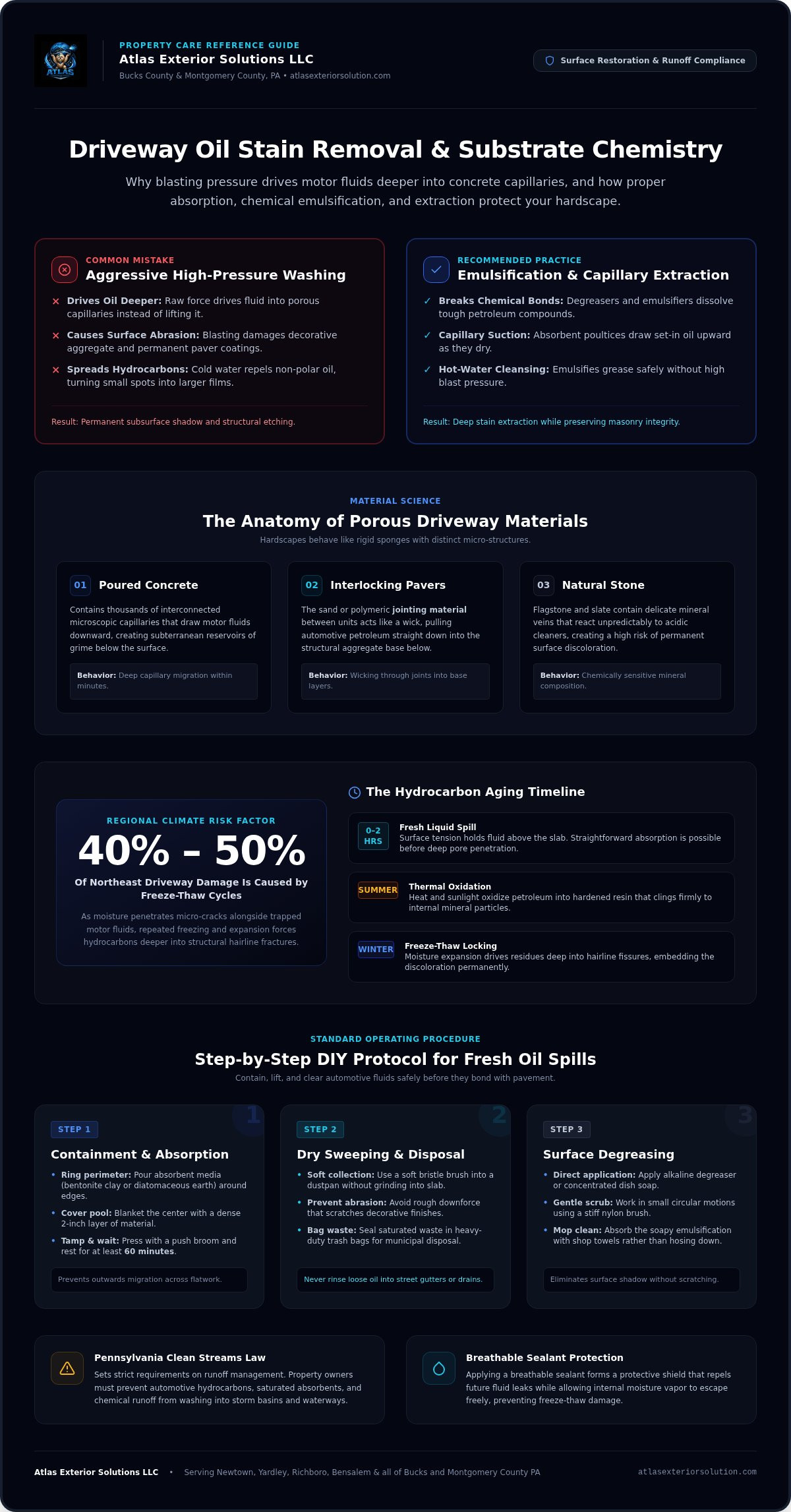
Most property owners view concrete or stone as solid rock, but standard flatwork actually behaves like a dense, rigid sponge. Microscopic air pockets and capillary pathways run throughout the material, creating a welcoming network for liquid contaminants. When an engine drips petroleum onto an unsealed surface, the hydrocarbons begin migrating downward within minutes. Grabbing a garden hose feels intuitive, but water and non-polar oil naturally repel each other, meaning cold water simply glides over the oily film, pushing it outward and expanding a small puddle into a sprawling mess. Achieving true oil stain removal driveway success requires breaking that chemical bond and reversing the inward migration.
The Anatomy of Porous Driveway Materials
Different paving materials react uniquely to vehicle leaks, which dictates how deeply a stain sets:
- Poured Concrete: Thousands of tiny interconnected capillaries draw motor fluids deep into the slab, creating a subterranean reservoir of grime.
- Interlocking Pavers: The sand or polymeric jointing material between pavers acts as a wick, pulling fluids straight down into the structural aggregate base beneath your driveway.
- Natural Stone: Slabs made from flagstone or slate often contain sensitive mineral veins that react unpredictably to acidic household degreasers, which risks surface discoloration.
Understanding how stain removers work reveals why a universal scrubbing approach usually fails on these varied surfaces. Every substrate demands a specialized touch.
Fresh Spills Versus Set-In Hydrocarbon Stains
Timing alters the fundamental chemistry of an oil spot. During the first hour or two, surface tension holds a portion of the fluid pool above the concrete, making initial recovery straightforward. Once intense summer sunlight beats down on the driveway, the heat accelerates oxidation, turning liquid petroleum into dark, hardened resin that clings tenaciously to mineral particles.
Winter brings its own set of complications to southeastern Pennsylvania. In the Northeast, freeze-thaw cycles are responsible for 40% to 50% of concrete driveway damage. As moisture seeps into micro-cracks alongside trapped motor fluids, the repetitive freezing and expansion forces those hydrocarbons deeper into the slab's structural hairline fractures. Over time, that seasonal pressure anchors the discoloration firmly beneath the surface layer, turning what started as a simple puddle into an embedded, long-term eyesore that ordinary surface scrubbing cannot dislodge.
Step-by-Step DIY Protocol for Fresh Driveway Oil Spills
Catching a leak the moment it drips onto your driveway gives you the best chance of restoring the surface without specialized tools. Quick action prevents hydrocarbons from migrating into microscopic concrete capillaries. Follow this structured process to contain, lift, and clear fresh fluids before they bond with the pavement.
Step 1: Immediate Containment and Absorption
Stop the puddle from expanding across your driveway immediately:
- Ring the perimeter: Pour a generous ring of absorbent granular media, such as bentonite clay litter or diatomaceous earth, around the outer edges of the fluid to prevent outward travel.
- Cover the pool: Blanket the center of the spill with a dense, two-inch layer of material.
- Lightly tamp: Press the granules downward with a stiff push broom to ensure direct contact with the pooling oil, then let it rest undisturbed for at least 60 minutes to draw out standing liquid.
Step 2: Dry Sweeping and Disposal
Once the absorbents have pulled the standing liquid off the surface, use a soft bristle brush to collect the granules into a dustpan. Avoid grinding saturated clay directly into the driveway, as rough downforce can cause surface abrasion on decorative coatings. Place all oily waste into a heavy-duty trash bag for municipal disposal.
Never rinse loose, oil-soaked dust toward the street. The Pennsylvania Clean Streams Law sets strict standards regarding stormwater pollution, requiring property owners to prevent automotive hydrocarbons and contaminated runoff from washing into neighborhood catch basins or local waterways.
Step 3: Surface Degreasing for Remaining Residue
After sweeping the bulk material, a light oily shadow will typically remain on top of the slab. Pour an alkaline degreaser or concentrated dishwashing detergent directly onto the spot, then scrub gently with a stiff nylon brush. Work in small circular motions to loosen residual grease without scratching the substrate.
Mop up the soapy emulsification with shop towels rather than washing it down the driveway grade. If a stubborn silhouette still lingers beneath the surface layer after the area dries, scheduling professional driveway cleaning can safely extract deep contaminants without scarring your hardscape.
Eliminating Deep, Stubborn Stains with Poultices and Emulsifiers
When an oil spill sits long enough to seep below the driveway surface, surface scrubbers lose their effectiveness. Simply washing the exterior cannot reach the hydrocarbons lodged in microscopic rock channels. A chemical poultice reverses concrete absorption by using evaporation to generate capillary suction, pulling dissolved petroleum fluids upward out of the substrate and into an absorbent powder matrix. Applying a paste directly over the dark silhouette creates an active extraction zone that lifts embedded grease without degrading the masonry beneath.
How to Build and Apply a Driveway Poultice
Creating an extraction paste at home requires combining a liquid solvent with an inert powder base:
- Select your base: Mix diatomaceous earth, talcum powder, or plain baking soda with an industrial solvent like acetone or a concentrated citrus degreaser until it reaches a peanut-butter consistency.
- Trowel the mixture: Spread the paste across the stain about a quarter-inch thick, extending past the visible edges by an inch.
- Seal and cure: Tape a sheet of plastic wrap over the mound to slow evaporation, letting the chemical penetrate downward for 12 hours. Then poke small air holes in the plastic to let the poultice dry completely over the next 12 to 24 hours.
Once the paste turns into dry, chalky powder, it has finished drawing fluid up into itself. Scrape the crust up using a rigid plastic putty knife to avoid surface abrasion, sweep the loose dust into a disposal bag, and wash the spot with warm water.
Microbial and Enzymatic Cleaners for Persistent Grease
Certain aged motor oil spots resist conventional solvent extraction, especially on delicate natural stone or older, brittle concrete. Biological cleaners offer an eco-conscious alternative by introducing billions of hydrocarbon-digesting microbes directly onto the hardscape. These specialized enzymes feed on petroleum molecules, transforming sticky greases into natural carbon dioxide and harmless water over a span of several days.
Patience remains the primary requirement for successful microbial oil stain removal driveway treatments. These living bacteria thrive in temperatures between 60 and 90 degrees Fahrenheit and require sustained moisture to remain active. Misting the treated section with water under a tarp allows the colonies to consume hardened resins down to the root of the stone without running foul of local runoff guidelines.
Why Professional Pressure Washing Outperforms DIY Surface Scrubbing
Homeowner pressure washers deliver cold water at high force, which creates a significant risk for unsealed flatwork. High blast pressure alone cannot dissolve petro-chemicals. Instead of lifting the stain, consumer equipment often causes permanent surface abrasion, carving permanent wand streaks directly into the concrete cream. True oil stain removal driveway remediation requires specialized thermal energy rather than raw mechanical force.
The Role of Commercial Hot-Water Extraction
Professional surface cleaners use integrated burners to heat water past 180 degrees Fahrenheit. This intense thermal delivery liquefies coagulated grease and breaks petroleum bonds within concrete pores instantly. Commercial rotary flat-surface cleaners disperse this heated spray evenly through twin rotating nozzles, which prevents zebra striping and ensures a uniform, restored appearance across your entire driveway.
Protecting Your Property and Complying with Local Regulations
Washing automotive fluids off a slab without containing the wastewater creates serious legal and environmental problems. The Pennsylvania Clean Streams Law prohibits sending oily wash water into neighborhood storm sewers, which feed directly into local waterways. Licensed contractors follow Power Washers of North America (PWNA) standards and employ specialized vacuum reclamation dams to trap oil-rich runoff on site.
Hiring a contractor who holds active general liability protection gives property owners complete peace of mind. Technicians who understand driveway cleaning in Bucks County follow these environmental mandates diligently while shielding your landscape from caustic runoff.
Request a free driveway cleaning estimate from Atlas Exterior Solutions LLC.
Paver Restorations Versus Standard Concrete Washes
Interlocking paver systems require a different technical touch than poured concrete slabs. High-pressure tips easily wash out the structural jointing material resting between stone units, which compromises the lateral stability of the entire driveway foundation.
Trained contractors rely on material-specific cleaning methods. They calibrate nozzle angles and pressure settings to purge oil spots from paver faces without blasting away the underlying bedding sand. After eliminating motor contaminants, learning how to restore old pavers with stabilizing polymeric sand and protective sealants ensures the structural cohesion of your hardscape remains intact for years to come.
Preventive Care: Sealing Your Driveway Against Future Leaks
Lifting deeply rooted engine grease restores flatwork to its original condition, but leaving bare aggregate unprotected invites immediate re-staining. Automotive fluids will simply reoccupy the microscopic channels that were just purged. Applying a high-grade surface barrier repels fresh petroleum, keeping fluids beaded on top of the slab where they can be wiped clean before causing permanent discoloration. Sealing concrete and pavers forms the essential concluding phase of lasting oil stain removal driveway care, safeguarding curb appeal while bolstering long-term structural resilience.
Choosing Between Breathable and High-Performance Sealants
Selecting the right formulation depends heavily on your specific pavement material and traffic loads:
- Penetrating Silane-Siloxane: This breathable sealant sinks beneath the wear layer to line internal capillaries without forming an artificial film. It repels liquid moisture and chemical spills from entering while allowing trapped sub-base water vapor to escape into the atmosphere freely.
- High-Performance Sealant: For high-traffic paver driveways, an advanced topical acrylic or urethane creates a durable, non-yellowing wear layer. This hard shell prevents oil penetration while locking in jointing material against heavy tire turning.
Because northeastern Pennsylvania experiences intense seasonal transitions, unsealed concrete risks severe cracking when moisture freezes inside microscopic cavities. A well-applied penetrating treatment shields internal pores against liquid saturation, mitigating freeze-thaw damage while ensuring automotive leaks wash away easily.
Ongoing Maintenance Routine for Bucks County Homeowners
Proactive care prevents the need for aggressive restorative cleaning down the road. Make it a habit to check high-traffic parking bays monthly for fresh fluid drips, dark engine weepage, or power steering leaks. Addressing minor fluid spots within the first twenty-four hours using absorbent media stops liquid migration before it reaches deep aggregate layers.
Autumn brings another common hazard across Bucks and Montgomery counties: falling foliage. Wet leaves sitting on flatwork release corrosive leaf tannins that leave stubborn organic shadows if ignored. Sweeping debris regularly and scheduling routine property maintenance keeps driveways, walkways, and patios uniformly bright.
Pairing annual flatwork washing with comprehensive exterior cleaning services maintains the structural integrity of your home's most prominent surfaces. Discover practical methods to improve curb appeal with exterior cleaning to preserve your real estate investment over every season.
If recurring automotive spots or stubborn grease stains resist standard DIY poultices, turn to the trusted local specialists. Contact Atlas Exterior Solutions LLC to evaluate your driveway, perform deep hot-water extraction, and apply professional-grade sealants that protect your hardscape for the long haul.
Restore and Protect Your Driveway for the Long Haul
Tackling automotive fluid leaks requires a balance of quick action and chemical patience. Fresh drips lift easily when contained with granular absorbents right away, while older spots demand poultice extraction rather than unguided high-pressure blasting. Choosing the right method preserves your masonry cream, keeps jointing sand stable, and prevents permanent surface abrasion across concrete or paver driveways.
When stubborn shadows refuse to budge, partnering with a certified specialist provides lasting peace of mind. Atlas Exterior Solutions LLC brings commercial hot-water extraction equipment directly to your property, lifting deep hydrocarbon deposits safely while complying with environmental standards. Backed by over 45 five-star Google reviews from property owners across Bucks and Montgomery counties, our fully licensed and insured technicians provide complete liability protection during every visit.
Taking proactive care of your flatwork today shields your hardscape against winter freeze-thaw cracking and restores true pride of ownership to your home's entrance. You don't have to live with dark, greasy silhouettes compromising your property's curb appeal.
Request your free driveway cleaning estimate from Atlas Exterior Solutions LLC
Frequently Asked Questions
Can cat litter completely remove an old motor oil stain from concrete?
No, cat litter only traps standing liquid sitting on top of the pavement. While bentonite clay pulls up fresh pools effectively, it lacks the chemical solvent power to extract hardened hydrocarbons that have soaked deep into internal pores. For older stains, property owners need an active chemical poultice or professional hot-water extraction to draw out subterranean residue.
Will high pressure washing damage my driveway during oil stain removal?
Yes, excessive blast pressure frequently gouges concrete and leaves visible wand stripes across flatwork. Forcing cold water into masonry at close range strips away the protective cream layer, exposing rough aggregate beneath. Safe oil stain removal driveway remediation uses controlled water pressure paired with commercial degreasers and heat, ensuring deep extraction without causing permanent surface abrasion.
How does hot water help remove vehicle oil better than cold water?
Hot water liquefies heavy petroleum grease by raising its temperature past 180 degrees Fahrenheit, which breaks down stubborn hydrocarbon bonds. Cold water simply beads up on greasy spots, sliding across the non-polar surface without dissolving it. Commercial heating units melt the vehicle oil instantly, allowing specialized detergents to emulsify the fluid so it lifts out of microscopic pores cleanly.
What should I do immediately after my car leaks oil on the driveway?
Blot the puddle right away using an absorbent medium like diatomaceous earth or clay litter, avoiding the urge to scrub or spray with a garden hose. Rinsing fresh oil spreads grease across a wider footprint and washes contaminants into storm sewers. Letting dry granular material sit undisturbed for an hour traps free-standing liquid before it migrates into porous stone.
Is it possible to remove years-old oil stains from driveway pavers?
Yes, older stains can be removed from pavers, but the process requires extra care to protect surrounding joints. Technicians combine enzyme treatments or chemical emulsifiers with heated extraction to pull out oxidized grease without disturbing delicate bedding sand. Once the stain lifts, sweeping fresh polymeric sand between individual units restores complete structural stability across your hardscape.
Does sealing a driveway stop oil from soaking into the surface?
Yes, high-grade penetrating sealers coat the inner walls of concrete pores to block chemical absorption. Rather than allowing petroleum to seep downward, a breathable sealant forces spilled oil to bead up on top of the driveway slab. This barrier gives property owners ample time to wipe up accidental automotive drips before they create deep, permanent grease shadows.
Disclaimer
The information on this blog is for general informational purposes only. Results may vary based on surface type, condition, and cleaning methods. Always follow manufacturer guidelines and use proper safety precautions. Atlas Exterior Solutions is not liable for any damages or losses resulting from the use of this information.


