

Clean pavers aren’t always sound pavers. If joint sand is washing away or units have shifted, another surface wash may brighten the area without fixing the underlying issue. Paver restoration can include cleaning, repairs, re-sanding, and sealing, with the right work depending on the surface and its joints.
It’s understandable to want a patio or walkway that looks refreshed and feels stable underfoot. The key is knowing whether routine washing is enough or whether eroded joints, uneven pavers, or persistent stains need more attention. Polymeric sand can help bind joints and discourage weeds, while a suitable sealer can make pavers easier to maintain and help protect them from stains.
This guide explains how professionals assess pavers, clean the surface, and determine whether re-sanding or sealing suits the job. You’ll also learn how weather affects treatment timing and how restoration can address worn joints or damaged areas. These details can help you understand options for your Bucks County home and choose a practical next step.
Key Takeaways
- Learn how professionals clean pavers while protecting sound joints from unnecessary sand loss.
- Understand how polymeric sand helps stabilize joints and what careful installation does to reduce washout.
- See why stains and sealer choices should match the paver material, especially for natural stone.
- Find out how weather and drying conditions affect the timing of sanding and sealing.
- Recognize the signs that call for a maintenance wash versus more extensive joint restoration.
Is paver sanding and sealing weather-dependent?
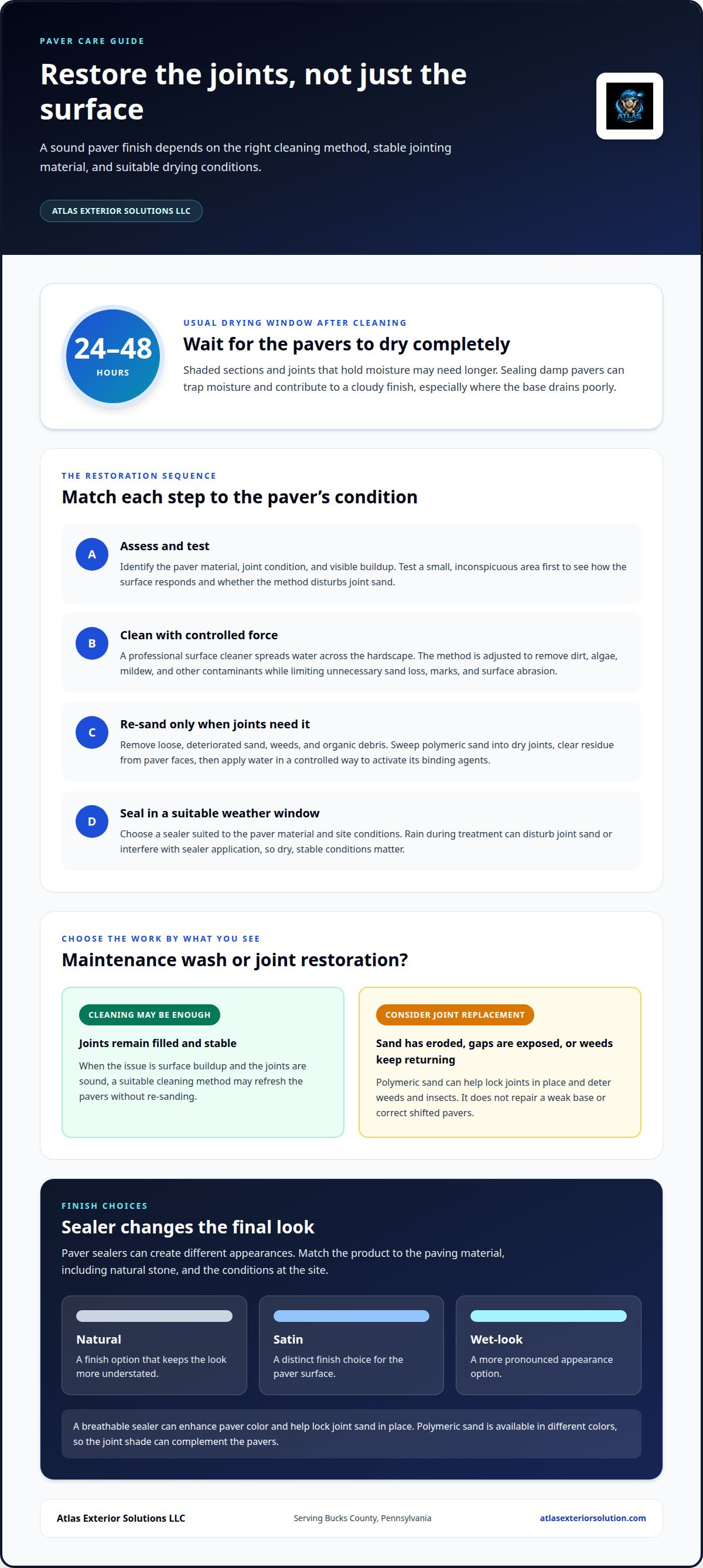
Yes. Weather affects paver restoration because cleaning, sanding, and sealing all depend on suitable conditions. Rain during treatment can disturb joint sand or interfere with sealer application. After cleaning, pavers should dry completely, usually 24 to 48 hours, before restoration treatment. Shaded sections and joints that hold moisture may take longer to dry than exposed paving.
Professional cleaning starts with the paver material, joint condition, and visible buildup. Professional-grade surface cleaners remove dirt, algae, mildew, and other contaminants from pavers. A surface cleaner spreads water across the hardscape instead of concentrating a narrow stream in one spot. The operator adjusts the method to protect sound joints and avoid unnecessary sand loss.
Before cleaning, the Concrete Masonry & Hardscapes Association recommends identifying stains and evaluating a small, inconspicuous test area. This shows how the paver responds before treatment reaches a larger section. A technician can observe whether the cleaner lifts soil, affects the surface, or disturbs joint sand. Those results guide the cleaning method for the rest of a patio or walkway.
Stain treatment depends on identifying the mark. Oil, rust, leaf tannins, and algae may need different cleaning agents or methods. A general cleaner may leave discoloration behind or affect sensitive paving. For natural stone, the Natural Stone Institute recommends identifying the stone before choosing cleaning products. A targeted test helps limit unwanted effects before broader treatment.
Pressure washing can remove embedded dirt, but excessive force or a poorly directed stream may erode joint sand, mark pavers, or cause surface abrasion. Controlled pressure washing methods account for paver condition and joint stability. A professional moves the cleaning head evenly and avoids directing concentrated water into vulnerable joints. Soft washing may suit buildup that responds to cleaning solutions and lower-pressure rinsing.
Weather matters after cleaning, too. Sealing damp pavers can trap moisture and contribute to a cloudy appearance, especially when the base drains poorly. Dry, stable conditions allow moisture to escape and help the treatment go on evenly. If rain is expected, scheduling sanding or sealing during a suitable weather window helps protect the finish.
Poorly performed paver restoration can wash out joint sand, mark pavers, leave stains untreated, or create a cloudy finish. Avoiding aggressive pressure, testing a small area, and waiting until the surface is fully dry before sealing can help prevent these problems. Well-timed paver restoration protects appearance and helps preserve stable joints.
Why Polymeric Sand is Better Than Regular Joint Sand
Regular joint sand fills the gaps between pavers, but it can erode over time. Polymeric sand contains binding agents that harden when activated with water. Once set, it helps lock pavers in place and deter weeds and insects. It can be useful for patios where loose sand repeatedly disappears or weeds return between paving units. It won’t repair a weak base or correct shifted pavers.
Joint blowout happens when water or cleaning force dislodges sand from between pavers. Professional installation helps reduce that risk by preparing the joints before adding new material. A technician removes loose, deteriorated sand and clears debris so the replacement can settle into the gaps. The joints also need to be dry before installation, since premature water activation can interfere with placement.
During re-sanding, a professional sweeps polymeric sand across the patio and works it into the joints. Excess sand is cleared from the paver faces before water activates the binding agents. This matters because residue left on the surface can adhere and become difficult to remove. Water is applied in a controlled way, rather than directed forcefully into the joints, to help limit washout.
Weeds and moss need attention before replacement sand goes in. A professional removes growth and organic debris from the joints, then assesses whether old material remains loose or degraded. Covering weeds with fresh sand can leave growth and debris beneath the new joint surface. Cleaning the gaps first gives the replacement material a clear path to fill them.
Polymeric sand comes in different colors, so you can choose a shade that complements the pavers rather than distracts from them. The overall finish also depends on the sealer. Paver sealers can create natural, satin, or wet-look finishes, each with a different appearance. A breathable sealer can enhance paver color and help lock joint sand in place, but it should suit the paving material and site conditions.
Re-sanding isn’t necessary every time a patio looks dirty. If joints remain filled and stable, cleaning may be enough. If sand has eroded, gaps are exposed, or weeds keep returning, professional joint replacement may be more appropriate. An assessment distinguishes surface buildup from deteriorated joint material, helping ensure the work addresses the actual issue.
For patios with recurring joint loss, an estimate for paver joint restoration can clarify whether cleaning, re-sanding, or both suit the surface. Polymeric sand supports joint stability, while careful preparation and water activation help preserve the finished work.
What Is Paver Restoration?
Paver restoration combines cleaning, repairs, joint work, and sealing to renew a hardscape. The right sequence depends on the material, stains, uneven areas, and existing finish.
Paver Sealer Selection and Application
Sealer selection starts with identifying the paver type and its condition. Concrete pavers and natural stone can respond differently, so one product may not suit both. The Natural Stone Institute recommends identifying stone composition before choosing cleaning products. Many natural stones don’t require sealing; an impregnating treatment can improve stain resistance without making stone stain-proof.
Before application, professionals consider surface moisture, drainage, and the existing finish. Pavers should dry completely, usually 24 to 48 hours after cleaning, before restoration treatment. These details help determine whether sealing is appropriate and which finish fits the material.
Old Sealer Removal
A professional may remove old sealer if it has failed, turned cloudy, or prevents a consistent new finish. The paver material and coating condition guide the stripping approach. The method should protect surrounding surfaces and avoid marking the pavers. After removal, the surface needs cleaning and drying before another treatment is applied.
Sealer removal is one factor that affects project scope, alongside stains, repairs, and the size of the area being treated. Atlas Exterior Solutions LLC can explain which steps are included in the proposed work and why they suit the surface.
Sealer Finish Options
Available finishes include natural, satin, and wet-look. Natural finishes change the appearance less, while satin and wet-look finishes add more visible sheen. Professionals consider the original paver color, material, and surrounding hardscape when discussing options. Sealer can enhance color and help protect against stains, but it doesn’t make pavers stain-proof or guarantee a slip-free surface when wet.
Resealing timing depends on exposure and use. High-traffic pavers are recommended for resealing every one to two years; moderate-use areas, every two to three years. No single sealer is best for every patio or walkway.
Restoration Steps and Paver Repairs
Professional paver restoration typically moves through assessment, cleaning, repairs, joint treatment, and sealing as needed. The professional identifies stains, checks for loose or uneven units, and determines whether sunken pavers should be reset or broken ones replaced. Drying time and repair needs affect the schedule; after cleaning, pavers usually need 24 to 48 hours to dry before treatment.
Permits or HOA approval depend on local requirements, governing documents, and the scope of the work, especially if structural changes are involved. Project scope also affects the estimate, including paver area, material, stain severity, repairs, and old sealer removal. A clear work plan should explain cleaning methods, repairs, and finish selection. A careful paver restoration assessment connects each step to the surface’s condition.
Paver protection from stains, UV fading, salt, and moisture
A suitable sealer can help limit stains and weathering while making pavers easier to maintain. The protection it provides depends on the paver material, surface condition, and maintenance routine.
Stain and Weathering Protection
On concrete pavers, sealing creates a barrier against staining and marking. It can also slow weed, mildew, mold, and algae growth. On a driveway, that can make oil marks easier to clean; on walkways, it can help reduce the impact of everyday soil. Sealing supports maintenance, but it doesn’t make pavers stain-proof.
Leaf tannins, oil, and rust each leave different marks. A professional identifies the stain and paver material before selecting a treatment. Sealed pavers are generally easier to clean, while routine rinsing helps remove dirt before it settles. Rinsing pavers with water monthly helps remove dirt and prevent staining.
Protection from UV, Salt, and Moisture
A suitable sealer can help protect paver color from UV exposure and reduce moisture entry. In a Bucks County winter, salt residue can remain on a driveway or walkway after snow and ice clear. Removing surface residue during regular maintenance helps limit buildup. Sealer choice matters, too: moisture trapped beneath an unsuitable coating can contribute to a cloudy appearance.
Natural stone needs a material-specific approach. Many natural stones don’t require sealing, and an impregnating treatment can improve stain resistance without making the stone stain-proof. A breathable sealant allows moisture vapor to escape while resisting liquid water entry. The stone’s composition and the surrounding drainage conditions help determine whether treatment is appropriate.
Concrete stain application is different from sealing. A color treatment changes the appearance of concrete pavers, while sealer provides a protective layer. Sealer should be applied after a paver color treatment has fully cured, usually 24 to 72 hours later. Applying the coating too soon can interfere with the finish and leave an inconsistent appearance.
Before sealing, a professional considers existing coatings, surface moisture, drainage, and the intended finish. Too much sealer can contribute to cloudiness, particularly where moisture remains or the base drains poorly. A test area can show how the coating affects color and sheen before work continues across the full patio or driveway.
Maintenance helps preserve the treatment. Keep dirt and organic debris from accumulating, and address fresh stains before they become harder to remove. High-quality concrete sealer is recommended as a preventive measure every two to three years. Actual maintenance needs depend on use and exposure, so inspect the surface for wear rather than relying only on the calendar.
Assessing whether pavers need maintenance washing or full re-sanding
A professional assessment distinguishes surface dirt from failing joints. If a patio looks dull but its joint sand remains firm and nearly level, maintenance washing may be enough. If gaps appear, sand has eroded, or weeds keep returning, re-sanding may be needed. The goal is to match the work to the condition, not treat every outdoor space alike.
The inspection covers the whole hardscape, not just its most visible stain. A professional looks for missing joint sand, loose pavers, weed growth, moss, and broken units. Pooled water in low spots is another sign that pavers may need restoration. For example, a dark, dirty patio with full joints suggests a different problem from a clean patio with visibly empty gaps.
Next, a professional distinguishes removable buildup from joint failure. Dirt, algae, mildew, or leaf tannins can affect pavers’ appearance without showing that joint sand needs replacement. Cleaning a small area helps show whether the surface responds and whether intact joints remain stable. If washing reveals open spaces or further sand loss, the assessment can shift toward re-sanding.
Joint condition is the clearest decision point. Stable sand filling the gaps supports a maintenance wash; crumbling, shallow, or missing material points toward replacement. A professional also checks whether the pavers move. Loose or uneven pavers can indicate a deeper support issue, which new sand alone won’t repair. The underlying condition should guide the scope.
Drainage and use add useful context. Water collecting repeatedly in one low spot may signal uneven paving or a drainage concern, rather than simple dirt. A driveway exposed to vehicle traffic can show joint wear differently from a lightly used garden path. The professional considers these patterns alongside staining, movement, and the amount of joint sand remaining.
Regular inspections help catch joint breakdown before weeds or shifting become more noticeable. Atlas Exterior Solutions LLC recommends inspecting joints every few years and re-sanding when they begin breaking down. That guidance complements a visual assessment: exposed gaps, recurring weeds, or sand that no longer stays in place indicate more than a cosmetic cleaning need.
The practical takeaway is simple: wash when the main issue is surface buildup and joints remain sound; re-sand when joint material is deteriorating. If pavers are broken, loose, or uneven, the assessment should account for repairs, too. This distinction helps protect the structure and appearance of patios, walkways, and other outdoor spaces without adding unnecessary work.
Atlas Exterior Solutions LLC: Paver Restoration
Atlas Exterior Solutions LLC provides paver restoration for Bucks County property owners whose patios, walkways, or driveways need professional attention. The work can address surface buildup, worn joint sand, stains, or uneven pavers through methods suited to the hardscape.
If your pavers mainly need cleaning, the right approach can refresh their appearance while protecting the surface. If joints have eroded or units have shifted, restoration may involve more than washing. An assessment helps identify the work needed for your outdoor space, whether it’s a home patio or commercial property in Bucks County or nearby Montgomery County.
For professional paver care in Bucks County, contact Atlas Exterior Solutions LLC to discuss your project.
Plan the next step for your pavers
Your outdoor space can feel welcoming and ready for everyday use when its paving receives care suited to its condition. Before choosing a treatment, consider how you use the patio, walkway, or driveway and what you want to improve. That gives a professional a clear starting point for discussing a practical restoration plan.
For homeowners and property managers in Bucks County, Atlas Exterior Solutions LLC offers paver restoration for worn or weathered hardscapes. Its services also include Soft Washing and Commercial Pressure Washing, supporting exterior upkeep for homes and businesses. The next step is a conversation about your pavers’ condition and the result you hope to achieve.
Thoughtful maintenance can help you take pride in your outdoor spaces and care for the property you value.
Frequently Asked Questions
Can I walk on it right after?
No. Keep pavers free of foot traffic for at least 24 hours after sealer application. Before work begins, plan how people will reach entrances without crossing the treated area. This is especially useful when a patio connects directly to a frequently used door. The professional can explain when the surface is ready for normal use and whether the treatment schedule affects access.
Do my pavers always need to be re-sanded when they're cleaned?
No. Cleaning and re-sanding address different conditions, so cleaning alone doesn’t require replacing joint material. For example, a paver area with full, stable joints may only need dirt removed. If the surface has isolated gaps, a professional can determine whether the concern is limited or widespread before recommending work. That distinction helps keep treatment focused on the actual condition.
How can a professional assess the condition of faded pavers?
A professional can compare exposed pavers with protected areas, such as stones beneath furniture or near a covered edge. The comparison helps show whether fading is consistent across the surface or concentrated in sun-exposed locations. The assessment should also account for stains and existing coatings, since either can change how color appears. This gives the professional a clearer basis for discussing treatment options.
Is sealing necessary?
No. Sealing isn’t required for every material, and it doesn’t correct structural problems. A sealer or joint stabilizer adds no structural capacity to a concrete paver system, so it won’t fix a weak base or stabilize sinking units. If pavers move or sit unevenly, address the underlying condition rather than relying on a coating. Material and surface condition should guide the sealing decision.
How does a professional determine whether pavers need a maintenance wash or full re-sanding?
A professional considers how much joint material remains and whether its condition varies across the area. A few isolated gaps may call for a different scope than joints breaking down across an entire patio. The inspection can include areas near drainage paths and heavily used sections, where wear may be more visible. This helps define whether work should cover a small area or the broader surface.
Why Do Pavers Fade?
Sun exposure and weathering can gradually change the appearance of pavers. Surface dirt or a stain can also make color look dull without the paver itself having faded. For example, a mark beneath a planter may remain darker than the surrounding surface. Distinguishing discoloration from fading helps set realistic expectations about what cleaning or a color treatment may change.
What does paver restoration include?
The scope depends on the condition and material of the paved area. Work may address surface cleaning, damaged units, joint material, or an existing coating, rather than applying every treatment to every project. For instance, a patio with intact units may not need the same repairs as one with cracked blocks. A clearly defined scope connects each task to an observed condition.
When should pavers be resealed, and what type of sealer is best?
Resealing timing depends on traffic and how the existing finish has worn. High-traffic areas may need attention sooner than moderately used patios, so inspect for uneven wear rather than relying only on appearance. The right product should suit the paver material and any existing coating. Finish preference matters, too, since natural, satin, and wet-look options create different appearances.
Disclaimer
The information on this blog is for general informational purposes only. Results may vary based on surface type, condition, and cleaning methods. Always follow manufacturer guidelines and use proper safety precautions. Atlas Exterior Solutions is not liable for any damages or losses resulting from the use of this information.


