

A powerful spray may remove green growth from vinyl siding, but it can also force water behind the panels or mark the surface. If you’re considering algae on vinyl siding removal, a safer approach is to treat the growth gently instead of relying on pressure.
You can get a clean result while taking care around your home and nearby plants. Start by looking at the pattern of the discoloration: algae, ordinary dirt, runoff marks, and other buildup can look similar, and the right cleaning method depends on the surface and what’s on it. Soft washing uses cleaning solutions and low-pressure water to address organic growth. Pressure washing relies more on water force, which may be too harsh for delicate siding.
This guide covers common signs of algae, a careful cleaning sequence, and ways to spot conditions that may encourage growth to return. It also explains when professional soft washing may be the safer option. For homeowners in Newtown, Yardley, and communities across Bucks County, including Richboro, Bensalem, Langhorne, Levittown, Horsham, Newtown Square, and Fairless Hills, material-specific cleaning can restore siding while helping protect the property.
Key Takeaways
- Learn how to distinguish possible algae growth from ordinary dirt and identify siding conditions that may encourage recurring buildup.
- For algae on vinyl siding removal, follow a careful cleaning sequence and the cleaner’s directions instead of relying on forceful scrubbing.
- Understand how soft washing uses cleaning solutions and low-pressure pumps, while pressure washing depends more on water force.
- Check shaded, moisture-prone areas during routine exterior maintenance to catch recurring growth early.
- See how professional soft washing can address siding buildup with a material-specific approach focused on protecting your home.
Why algae grows on vinyl siding, and how to recognize it
Algae on siding is surface growth that can leave green or dark discoloration where moisture lingers and sunlight is limited. Algae are a broad group of organisms that includes forms able to grow in damp outdoor environments. For a plain-language overview, see What is Algae? Its presence on vinyl doesn’t automatically mean the siding is damaged, but recurring buildup can stain the exterior and point to areas that stay damp.
Shade, moisture, and limited airflow can all contribute, although no single cause explains every patch. A wall shaded by trees, a sheltered corner, or a section that dries slowly may be more prone to recurring surface growth. For Bucks County homeowners, noticing where marks appear can help distinguish a persistent damp area from a one-time layer of outdoor dirt.
What does algae on vinyl siding look like?
Possible signs include a green film, narrow streaks, or shaded patches that appear strongest on parts of the wall that receive less sun. Appearance alone can’t confirm algae. Ordinary dirt, runoff marks, staining, and other organic buildup may look similar, so don’t treat color as a definitive diagnosis.
Look at the location and pattern. Does the discoloration gather under a shaded eave, near a sheltered corner, or along one section of siding? Does it remain after ordinary rain or return in the same spot? Rain may rinse loose dirt, but it doesn’t reliably remove established growth. Persistence is a useful clue, not proof. Careful observation helps you choose an appropriate next step for algae on vinyl siding removal without starting with harsh scrubbing.
Why do shaded siding areas get algae?
Algae can establish more readily where surfaces stay damp and receive less direct sunlight. Trees may shade a wall and limit airflow, while protected areas can dry slowly after rain. These conditions can encourage growth, but they don’t guarantee algae will appear. Other sources of discoloration can also create similar patterns.
If a patch repeatedly returns, consider its setting as well as its color. Compare it with nearby siding that gets more sun or dries faster, and note whether the affected area is sheltered or regularly damp. That context can help you decide whether you’re seeing recurring growth or another kind of buildup. Identifying the likely cause first supports a gentler, more informed cleaning decision.
How to remove algae from vinyl siding without damaging it
Safe cleaning starts with the siding, not the sprayer. Check for loose, cracked, or damaged panels, and pay attention to seams, vents, and openings where water could enter. If the siding is in poor condition or the buildup is extensive, don’t experiment with stronger pressure or harsher cleaning agents.
A careful DIY cleaning sequence for vinyl siding
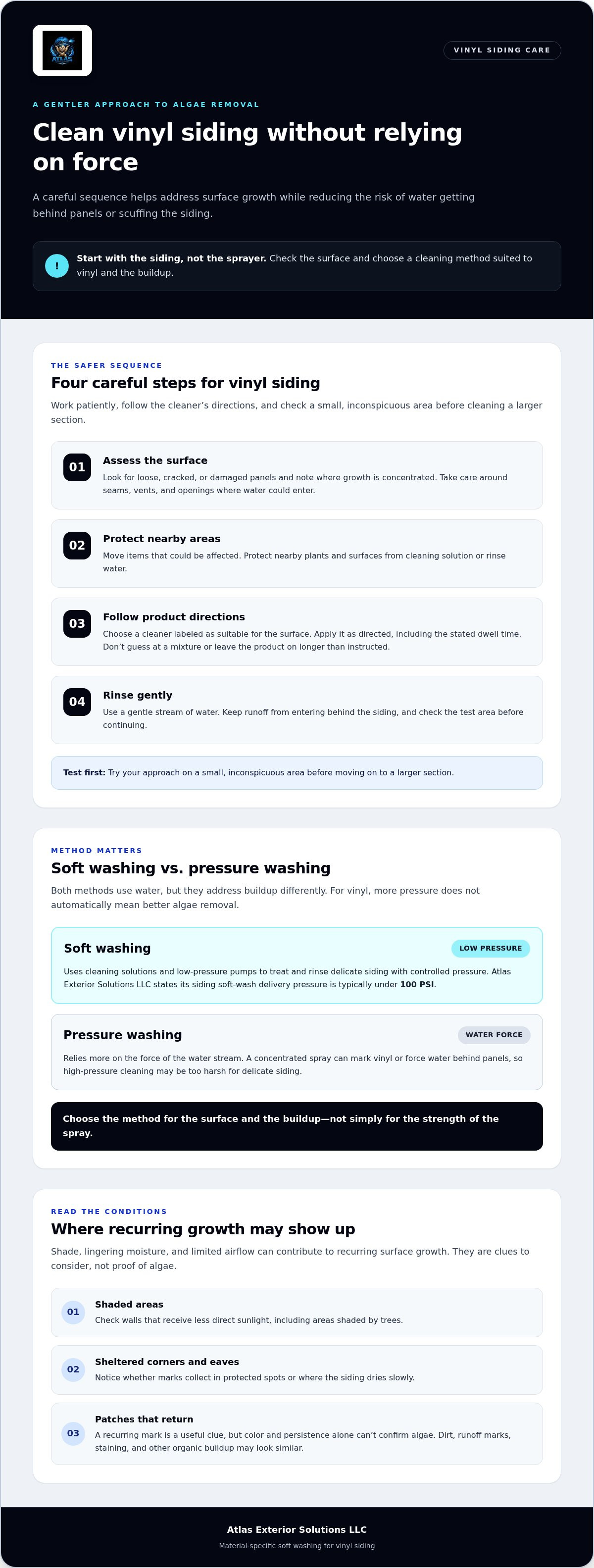
Work patiently and test your approach on a small, inconspicuous area before cleaning a larger section:
- Assess the surface: Look for damage and note where the growth is concentrated. Don’t direct water into gaps or openings.
- Protect nearby areas: Move items that could be affected, and protect nearby plants and surfaces from cleaning solution or rinse water.
- Follow product directions: Choose a cleaner labeled as suitable for the surface. Apply it as directed, including the stated dwell time. Don’t guess at a mixture or leave the product on longer than instructed.
- Rinse gently: Use a gentle stream of water. Work carefully so runoff doesn’t enter behind the siding, and check the test area before continuing.
The guide Removing Algae from Vinyl Siding also discusses practical cleaning considerations. Follow the directions for the cleaner you choose, since products and instructions can vary.
Why pressure and scrubbing need restraint
Vinyl siding doesn’t need forceful treatment to look clean. A concentrated spray can damage the surface or drive water behind panels. Stiff or abrasive tools may cause surface abrasion, leaving vinyl scuffed or dull. If a mark doesn’t lift with a gentle approach, pressing harder can create a new problem without resolving the cause.
Soft washing uses low-pressure pumps to apply cleaning solutions and rinse delicate siding. High-pressure cleaning depends on force, which can put vinyl and the areas behind it at risk. For stubborn growth, a surface-specific soft-washing approach can address buildup without relying on an aggressive spray. Atlas Exterior Solutions LLC uses low-pressure soft washing for siding, with delivery pressure typically under 100 PSI. Learn more about soft washing for Bucks County homes.
Soft washing vs. pressure washing for algae on vinyl siding
Both methods use water, but they remove buildup differently. Pressure washing relies more on the force of the water stream. Soft washing uses low-pressure pumps to apply cleaning solutions and rinse the surface with controlled pressure. For vinyl siding, that distinction matters: the goal is to address algae without putting unnecessary force on panels, seams, or surrounding areas.
More pressure doesn’t automatically mean better algae removal. Results depend on choosing a method suited to the siding and the type of buildup. For a related overview of algae and cleaning considerations, see Causes and Removal of Green Algae.
When is soft washing the better fit for vinyl?
Soft washing can suit delicate siding when the goal is to clean without depending on a forceful spray. A suitable cleaning solution helps address organic buildup, and a gentle rinse clears the treated surface. Atlas Exterior Solutions LLC’s soft-washing delivery pressure is typically under 100 PSI. The process focuses on controlled application rather than trying to blast algae away.
Learn more about professional soft washing for siding and how this approach supports exterior care.
Can pressure washing damage vinyl siding?
Yes. Excessive pressure or poor technique can damage siding or push water behind panels, especially when the stream is aimed at seams or openings. The risk depends on the equipment, how it’s handled, and the condition of the surface. Vinyl that’s loose, cracked, or already compromised needs particular care.
Compare the methods by how they clean and the risks involved:
- Soft washing: Cleaning solution does much of the work, followed by a controlled, low-pressure rinse. This can suit delicate siding when the solution and process are appropriate for the surface.
- Pressure washing: A stronger water stream provides more mechanical force. If the pressure or spray direction isn’t suited to vinyl, it can cause surface damage or water intrusion.
For algae on vinyl siding removal, choose a method based on the siding’s condition and vulnerabilities, not the assumption that a stronger stream will clean better. If buildup persists or the panels are delicate, material-specific soft washing can help protect the exterior while addressing the growth.
How to prevent algae from returning to vinyl siding
Cleaning removes existing buildup, but it can’t guarantee algae won’t return. The practical goal is to notice changes early and reduce conditions that keep siding damp where possible. A quick look during routine exterior maintenance can help you spot recurring patches before they cover a larger area.
What can homeowners do between cleanings?
Check shaded walls and sections where growth has appeared before. Look for persistent dampness or obvious sources of runoff, and address them where practical. If a small patch returns, note its location and monitor it rather than waiting until the discoloration spreads.
- Look over shaded siding and previously affected spots.
- Notice areas that stay damp or receive runoff.
- Watch for early green film, streaks, or discoloration.
- Arrange suitable cleaning if visible growth begins to spread.
These checks are useful for homeowners in Bucks County, where conditions can vary from one side of a home to another. A recurring patch may point to a local moisture or shade pattern, but appearance alone doesn’t confirm the cause. If you’re considering algae on vinyl siding removal, identifying where growth returns can help guide a careful cleaning plan.
When does recurring algae call for professional attention?
Widespread or persistent growth can be difficult to clean evenly. Patches in hard-to-reach areas may also be challenging to assess safely. Siding that’s loose, damaged, or brittle needs careful attention before cleaning because added pressure or rough handling could worsen existing problems. A material-specific approach accounts for the siding’s condition instead of treating every section the same way.
For more exterior-care context, read our house washing guidance for Bucks County homeowners. If recurring growth is difficult to manage, Atlas Exterior Solutions LLC provides low-pressure soft washing for siding, focusing on protecting the surface while addressing buildup.
Professional algae removal for vinyl siding in Bucks County
Professional siding cleaning starts with understanding the surface, its condition, and the pattern of growth. Algae concentrated on one shaded wall may call for a different approach from buildup spread across several sides of a home. A careful assessment helps match the cleaning method to the vinyl and address visible growth without unnecessary force.
What to expect from professional vinyl siding cleaning
A surface-specific process considers both the siding and the areas around it. The work typically involves assessing panels and seams, protecting nearby surfaces, applying a controlled cleaning treatment, and rinsing carefully. The pattern of growth and the siding’s condition guide the approach, rather than applying the same treatment to every surface.
For a broader look at local exterior care, explore Atlas’s soft washing services. This low-pressure method addresses algae and other buildup on siding while helping protect delicate exterior surfaces.
How Atlas protects siding during soft washing
Atlas Exterior Solutions LLC is locally owned and fully insured, serving homeowners across Bucks County and nearby communities in Montgomery County, including Newtown, Yardley, Richboro, Bensalem, Langhorne, Levittown, Horsham, Newtown Square, and Fairless Hills. Its soft-washing delivery pressure is typically under 100 PSI. Rather than using a forceful stream to blast growth from vinyl, the process applies cleaning solutions at low pressure, then rinses the surface in a controlled way.
That measured approach helps limit the risk of surface damage and water being driven behind siding while addressing the buildup. Careful exterior maintenance also means paying attention to the siding’s condition and protecting the surrounding property during cleaning. For algae on vinyl siding removal, professional soft washing can be a practical option when growth is widespread, recurring, or difficult to reach safely.
Protect Your Siding With a Gentle Cleaning Plan
Green or dark marks may indicate algae, but dirt and other buildup can look similar. Notice where discoloration appears and whether it returns, especially on shaded or slow-drying sections. For algae on vinyl siding removal, begin with a surface-appropriate method: follow cleaner directions, rinse gently, and avoid forceful sprays or abrasive scrubbing that could harm the panels.
Soft washing treats growth with cleaning solutions and low-pressure water rather than relying on force. Atlas Exterior Solutions LLC is a locally owned and operated, fully insured exterior-cleaning company serving Bucks County. Its soft-washing delivery pressure is typically under 100 PSI. Routine checks can help you catch regrowth early, though no cleaning method can promise it will never return.
If buildup is widespread, difficult to reach, or recurring, professional soft washing can help restore your siding while protecting your home.
With the right attention and a gentle approach, you can keep your home’s exterior looking cared for.
Frequently Asked Questions
How do you remove algae from vinyl siding?
For algae on vinyl siding removal, first assess the panels, then test a suitable siding cleaner on a small, inconspicuous area. Protect nearby surfaces, follow the product label for application and dwell time, and rinse with a gentle stream. Avoid abrasive tools and forceful sprays, which can scuff vinyl or push water behind the panels. If growth is widespread or difficult to reach, professional soft washing may be a safer option.
Can you use a pressure washer on vinyl siding?
A pressure washer can pose risks to vinyl siding if the pressure or spray direction is unsuitable. Excessive force may damage panels or drive water behind them, especially around seams and openings. Machines and techniques vary, so the equipment alone doesn’t determine the outcome. For delicate siding, a low-pressure method is generally a more cautious choice. Avoid aiming a concentrated stream directly at seams, edges, or damaged sections.
Is soft washing safe for vinyl siding?
Soft washing can suit vinyl siding when the cleaning solution, application, and rinse are matched to the surface. It uses low-pressure pumps to apply cleaning agents and rinse without relying on a forceful stream. Atlas Exterior Solutions LLC’s typical soft-washing delivery pressure is under 100 PSI. Following product directions and considering the siding’s condition helps protect the panels and surrounding property.
Why does algae keep coming back on my siding?
Algae may return where siding stays damp, shaded, or slow to dry. Walls shaded by trees, sheltered corners, and areas exposed to recurring runoff can be more prone to surface growth, although these conditions don’t guarantee algae will appear. Check the same areas during routine exterior maintenance and note whether discoloration returns. Cleaning removes existing buildup, but it can’t permanently change shade or moisture conditions that may encourage regrowth.
Will cleaning algae damage the color or finish of vinyl siding?
Careful cleaning shouldn’t require forceful scrubbing, but the wrong product or technique can affect the surface. Abrasive tools may scuff or dull vinyl, and unsuitable cleaning agents may leave marks or alter the finish. Test a cleaner on a small, hidden section, follow its label, and rinse gently. If the siding is brittle, damaged, or already discolored, take extra care before attempting to clean it.
How often should vinyl siding be cleaned to prevent algae?
There isn’t one cleaning schedule that prevents algae on every home. The need depends on factors such as shade, moisture, and whether growth has appeared before. Instead of relying on a fixed interval, inspect shaded and previously affected areas during routine exterior maintenance. If you notice new growth, address it before it spreads. Regular observation can guide timely care, but no cleaning method can guarantee algae won’t return.
Should I remove algae from vinyl siding myself or hire a professional?
You may be able to clean a small, accessible area yourself if the siding is in good condition and you follow cleaner directions carefully. Consider professional soft washing for widespread or recurring growth, hard-to-reach sections, or loose, damaged, or brittle panels that need careful assessment. Atlas Exterior Solutions LLC serves homeowners in Bucks and Montgomery Counties, including Newtown, Yardley, Richboro, Bensalem, Langhorne, Levittown, Horsham, Newtown Square, and Fairless Hills.
Disclaimer
The information on this blog is for general informational purposes only. Results may vary based on surface type, condition, and cleaning methods. Always follow manufacturer guidelines and use proper safety precautions. Atlas Exterior Solutions is not liable for any damages or losses resulting from the use of this information.


