

What if the high-pressure blast you think is cleaning your home is actually forcing moisture deep into your wall cavities? If you've noticed unsightly green algae or black spots, you're likely looking for the best way to remove mold from house siding without causing lasting harm. Most Bucks County homeowners take great pride in their property, yet they often find themselves stuck in a cycle of ineffective DIY scrubbing. It's frustrating to see organic growth return just weeks after you've worked so hard to clear it away.
You deserve a clean, healthy exterior that reflects the care you put into your home. This 2026 guide shares professional-grade methods to eliminate mold and mildew while protecting your investment. We'll walk through the essential differences between high-pressure cleaning and the soft washing techniques used to preserve delicate surfaces. You'll gain a clear understanding of how to treat the root cause of growth and what steps you can take to prevent those stubborn green streaks from coming back.
Key Takeaways
- Understand how the unique humidity and seasonal shifts in Bucks County contribute to the growth of green algae and black mold on your siding.
- Learn why traditional high-pressure washing often leads to hidden water intrusion and permanent surface scarring on vinyl and wood.
- Discover the professional-grade chemistry needed to safely remove mold from house siding while sanitizing the surface to prevent rapid regrowth.
- Identify the specific safety gear and mixing ratios required to handle minor DIY cleaning projects without risking damage to your home’s exterior.
- Determine when a heavy infestation or a multi-story home requires the specialized low-pressure soft washing techniques used by local professionals.
Understanding Why Mold and Mildew Thrive on Your Siding
Bucks County homes face a unique set of environmental challenges that make organic growth almost inevitable. The transition from humid summers to damp, cool springs creates a perfect incubator for various biological colonies. While many homeowners see green or black patches and think of them as simple dirt, they're actually dealing with complex living organisms. To effectively remove mold from house siding, you must first understand the life cycle of these invaders. What is mold? It's a living fungus that thrives on moisture and organic matter; this means it requires a specialized biocide rather than just high pressure water to be fully eradicated.
In our local area, you'll typically see two distinct types of growth. Green algae is common and relatively harmless to the structure, though it's an eyesore that can make your home look neglected. Black mold is a more serious concern because it can indicate deeper moisture issues and may pose health or structural risks if it penetrates the building envelope. Mold is a living organism that requires a professional strength biocide, not just a water rinse, to ensure complete removal.
The Role of Shade and North-Facing Walls
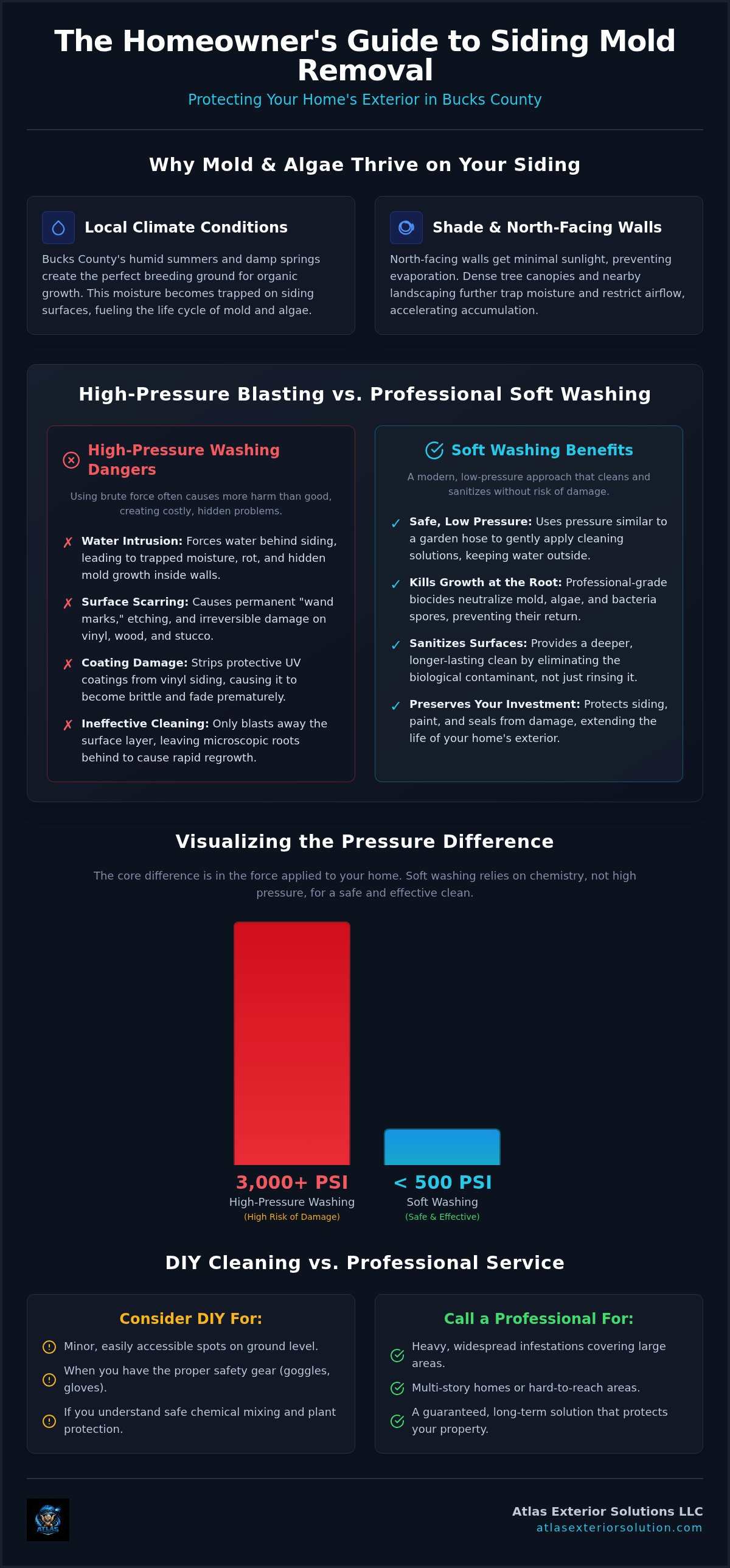
Most homeowners notice that the "green side" of their house is almost always the north-facing wall. This happens because north-facing surfaces receive the least amount of direct sunlight, which prevents morning dew and rainwater from evaporating. In wooded communities like Newtown and Yardley, the dense tree canopy provides additional shade that keeps siding damp for hours or even days. This trapped moisture settles into the grain of wood or the microscopic texture of vinyl siding. Nearby landscaping can also restrict airflow, creating stagnant pockets of air where mold and mildew accumulation accelerates.
Organic Growth vs. Environmental Staining
It's easy to mistake living growth for simple environmental staining like dirt, soot, or pollen. However, the black streaks often seen on roofs and siding are frequently caused by Gloeocapsa Magma, a hardy type of bacteria that feeds on the minerals found in many exterior materials. Unlike common dust, these living spores are incredibly resilient. If you only use a garden hose to remove mold from house siding, the invisible roots often remain behind in the pores of the material. This is why many DIY attempts result in the mold returning within a few months. At Atlas Exterior Solutions LLC, we treat these colonies as a biological issue rather than a cosmetic one. A successful house washing process requires a chemical treatment that neutralizes the spores at their source, ensuring the surface is sanitized rather than just rinsed.
The Risks of Using High Pressure to Remove Mold
While it's tempting to reach for a high-powered pressure washer to quickly blast away green streaks, this approach often causes more harm than good. Residential siding is designed to shed rainwater falling vertically, not to withstand a concentrated stream of water delivered at 3,000 PSI from a horizontal angle. When you attempt to remove mold from house siding with excessive force, you risk compromising the very barrier meant to protect your home's structural integrity. Following CDC mold cleanup safety guidelines is a vital first step for your personal health, but protecting your property requires a technical understanding of material limits.
Water Intrusion and Mold Behind the Siding
High-pressure streams can easily bypass the weep holes and overlapping seams of your siding panels. Once water is forced behind the exterior cladding, it becomes trapped against the house wrap or sheathing. This moisture has nowhere to evaporate, which often leads to hidden wall rot and the creation of a "mold sandwich" between your siding and the interior drywall. This is why professional house washing in Bucks County focuses on low-pressure chemical applications rather than raw mechanical force. Keeping the water on the outside of the envelope is the only way to ensure long-term preservation.
Scarring and Surface Damage
Inexperienced operators often leave permanent "wand marks" or etchings on vinyl and wood surfaces. These scars occur when the high-pressure nozzle is held too close to the siding, physically moving the material or stripping away its finish. Beyond visible marks, excessive pressure can remove the protective UV coating from vinyl siding, which causes it to become brittle and fade prematurely in the sun. If your siding has developed a chalky film known as oxidation, high pressure will clean it unevenly, leaving a splotchy and unattractive appearance that is nearly impossible to fix without replacement.
You should also consider your home's warranty before starting. Most modern siding manufacturers specifically recommend low-pressure cleaning methods; using high pressure can actually void your coverage for future material failures. Choosing a specialized soft washing approach allows you to achieve a deeper clean by killing the organic roots without the risk of physical destruction. It's a safer way to maintain your home's value while ensuring the mold doesn't simply return from the moisture you've forced into the walls.
Identifying the Best Solutions to Kill Mold Spores
To effectively remove mold from house siding, you must prioritize chemistry over sheer force. Many homeowners reach for household vinegar or dish soap, hoping for a gentle solution. While these can lift some surface-level grime, they lack the biological punch needed to kill the root systems of resilient mold colonies. Sodium Hypochlorite remains the industry standard because it acts as a true biocide, neutralizing spores on contact. It's a common misconception that a "clean" bleach smell indicates a job well done; in reality, a clean smell doesn't always mean the spores are dead, as the scent can linger even if the application was too brief to be effective.
The Science of Surfactants
Surface tension is a primary obstacle when you try to remove mold from house siding. Standard liquids tend to bead up and run off vertical surfaces before they can perform their job. Professional-grade surfactants are specialized agents designed to break this tension, allowing the cleaning solution to spread evenly and "cling" to the siding. This increased dwell time ensures the biocide has enough time to sanitize the material without drying out. Unlike store-bought concentrations that are often diluted for general use, contractor-grade surfactants are formulated to remain stable and effective even on hot vinyl or porous wood surfaces.
Protecting Your Local Ecosystem
Homeowners in Yardley and Newtown often express concern about how cleaning agents might affect their pets, children, and landscaping. Protecting your backyard oasis is a critical part of a professional cleaning strategy. The most effective method for safety is a process called pre-wetting. By saturating your plants and soil with fresh water before and during the application, you create a protective barrier that prevents chemical burn. Using biodegradable solutions is also a vital step in protecting the delicate Bucks County watershed. During a soft washing service, Atlas Exterior Solutions LLC carefully manages runoff to ensure your property remains as healthy as it is clean. This meticulous approach provides peace of mind, ensuring your home's renewal doesn't come at the expense of your garden's health.
Step-by-Step Guide: How to Safely Remove Light Mold Buildup (DIY)
For minor patches of organic growth, a hands-on approach can often restore your home's curb appeal. However, the process to remove mold from house siding requires more than just a bucket of soapy water; it demands a systematic method to ensure safety and prevent permanent staining. Before you begin, gather a standard garden hose with a spray nozzle, a soft-bristled brush for stubborn spots, and a sturdy plastic bucket for mixing your solution.
Preparation and Safety Gear
Personal safety is the foundation of any successful home maintenance project. You should always wear wrap-around eye protection and chemical-resistant gloves to protect yourself from splashes. Never use a ladder on a wet surface; if you can't reach a spot from the ground using a telescoping pole or a high-reach nozzle, it's safer to call a professional. Take a few minutes to cover all exterior electrical outlets with plastic and tape, and ensure all windows are tightly closed. It's also wise to move patio furniture and outdoor decor away from the work area to protect your driveway and concrete surfaces from accidental chemical exposure.
A reliable DIY solution for light mold consists of one part household bleach mixed with four parts water, plus a small amount of laundry detergent to act as a basic surfactant. This mixture is powerful enough to kill surface spores without being overly aggressive on your siding's finish.
The Application and Dwell Process
The most common mistake in a DIY cleanup is applying the solution from the top down. This causes dirty runoff to create permanent streaks on the dry siding below. Instead, apply your mixture from the bottom to the top. This ensures the surface is wet and primed as you work your way up. Once the siding is saturated, let the solution dwell for 5 to 10 minutes. You'll know the treatment is working when you see the green algae change to a dull brown or clear color.
Never let the solution dry on the siding, especially on warm days, as this can lead to hazy white spots that are difficult to remove. If the mold is particularly thick, use a soft-bristled brush to gently agitate the area. Avoid aggressive scrubbing, which can scratch vinyl or strip paint. Finally, rinse the entire surface from the top to the bottom to ensure every trace of the cleaning agent and organic debris is washed away. This ensures you remove mold from house siding completely while leaving a streak-free finish.
Request a professional house washing service
When to Call a Professional: The Long-Term Preservation Strategy
While the DIY methods previously discussed are suitable for light maintenance, certain scenarios demand specialized intervention. If you're dealing with a multi-story home or a heavy infestation that has sat for years, attempting to remove mold from house siding on your own can lead to injury or incomplete results. Professional teams bring the technical expertise to reach high peaks and sanitize difficult surfaces without the safety risks associated with homeowner-grade equipment. Relying on an expert ensures that the organic growth is fully eradicated, rather than just moved around by a garden hose.
Professional soft washing keeps mold away longer than high-pressure blasting because it addresses the biological health of the surface. It's a comprehensive sanitization process that protects your home's long-term integrity while providing a level of cleanliness that lasts through several seasons. This methodical approach is the most reliable way to maintain your home's value without the risks of water intrusion mentioned earlier.
Expert Insight vs. DIY Trial and Error
Professionals don't just apply a standard solution; they calibrate chemical ratios based on the specific porosity of vinyl, wood, or stucco. This precision ensures that organic growth is neutralized without stripping the material's finish or leaving behind hazy residue. High-volume, low-pressure equipment allows for a more uniform application than a standard garden hose can match, creating a clean that enhances curb appeal for years, not just weeks. For a comprehensive maintenance plan, consult The Ultimate Guide to House Washing in Bucks County: 2026 Homeowner Edition.
Peace of Mind with Atlas Exterior Solutions LLC
Choosing a fully insured, locally owned company provides a level of accountability that casual labor cannot offer. Atlas Exterior Solutions LLC is deeply rooted in the Bucks County community, serving residents from Bensalem to Newtown Square with a focus on long-term structural health. We don't just wash surfaces; we act as meticulous guardians for your property's most valuable assets. Our methods prioritize preservation across all our offerings, including specialized paver restoration and roof treatments. This professional approach ensures you remove mold from house siding safely while maintaining the manufacturer warranties that protect your investment.
Contact Atlas Exterior Solutions LLC for a free estimate on your home's restoration.
Secure the Future of Your Home’s Exterior
Protecting your home starts with choosing methods that prioritize long-term health over a quick, aggressive fix. You now understand that to effectively remove mold from house siding, you must look beyond the surface and address the biological roots of organic growth. By opting for specialized soft washing instead of risky high-pressure methods, you prevent water intrusion and preserve the delicate finish of your vinyl or wood siding.
As a fully insured and locally owned provider, Atlas Exterior Solutions LLC takes pride in being a meticulous guardian for properties across Newtown, Yardley, and all of Bucks County. Our specialized soft washing experts are dedicated to restoring your home’s beauty while ensuring its structural integrity remains intact for years to come. We understand the specific environmental challenges of our local area and use that knowledge to provide a superior, lasting clean.
Get a Free Quote for Professional House Washing in Bucks County
You don't have to tackle heavy infestations or high peaks alone when professional care is just a phone call away. We look forward to helping you restore your home's pride of ownership and ensuring your exterior remains a source of beauty for your family.
Frequently Asked Questions
Is mold on my siding dangerous to my family's health?
Exterior mold is generally less hazardous than indoor growth, but it can still trigger respiratory issues for sensitive individuals. When spores are present near windows, doors, or HVAC intakes, they can easily be drawn into your living spaces. Removing these colonies early prevents them from becoming a larger health concern or leading to structural rot that compromises your home's integrity and long term value.
Can I use straight bleach to remove mold from my house siding?
You should never use straight bleach because its high concentration can permanently discolor vinyl or strip the finish from wood. A diluted mixture is the only safe way to remove mold from house siding without causing chemical burns to your landscaping or pets. Professionals use specifically balanced ratios and surfactants that kill the fungus while remaining gentle on your home's delicate exterior surfaces.
How much does it cost to have a professional remove mold from siding in Bucks County?
Professional costs depend on the total square footage of your home and the severity of the infestation. Every project is unique, as the height of the structure and the type of siding material influence the labor required. You should request a personalized estimate from a local provider to get an accurate quote that reflects the specific needs and challenges of your property's exterior restoration.
Will the mold on my siding come back after it is cleaned?
Mold will eventually return if the underlying moisture and shade conditions aren't addressed. However, professional soft washing keeps surfaces clean much longer than traditional pressure washing because it kills the invisible root systems. Regular maintenance ensures that spores don't have the opportunity to establish a deep colony on your walls, providing you with lasting peace of mind and improved curb appeal.
Does soft washing kill the plants in my garden?
Soft washing won't harm your landscaping if the technician follows proper safety protocols like pre-wetting and rinsing. Saturating your plants with fresh water before the treatment prevents them from absorbing any cleaning solution. This meticulous approach ensures that your garden stays healthy while your home's siding is being restored, protecting your most valuable outdoor assets throughout the entire cleaning process.
What is the difference between green algae and black mold on siding?
Green algae is a plant-like organism that usually appears on sunnier walls, while black mold is a fungus that prefers damp, shaded areas. Algae is mostly a cosmetic problem that affects your curb appeal. Black mold is more aggressive and can eventually lead to wood rot or penetrate the building's envelope if it is left untreated for an extended period of time.
How often should I have my house washed to prevent mold buildup?
Most local homeowners find that an annual or biennial cleaning is sufficient to keep their exteriors in top shape. If your home is surrounded by a dense tree canopy or sits in a particularly humid part of the county, a yearly schedule is the most effective way to remove mold from house siding. This proactive strategy prevents organic growth from staining the material permanently.
Can I use a regular pressure washer if I turn the setting down?
You can use a pressure washer on a low setting, but it often lacks the specialized nozzles required for a true soft wash. Success depends more on the cleaning chemistry than the water pressure itself. Without the right biocides, you're simply rinsing the surface rather than sanitizing it, which allows the spores to return quickly and potentially damage your home's finish over time.
Disclaimer
The information on this blog is for general informational purposes only. Results may vary based on surface type, condition, and cleaning methods. Always follow manufacturer guidelines and use proper safety precautions. Atlas Exterior Solutions is not liable for any damages or losses resulting from the use of this information.


