

What if you could clean your roof without forceful water that risks loosening shingles? Low pressure roof cleaning uses controlled application rather than an aggressive rinse to address algae, moss, and stains while helping protect delicate roof surfaces. If you’re concerned that cleaning could do more harm than good, the method matters.
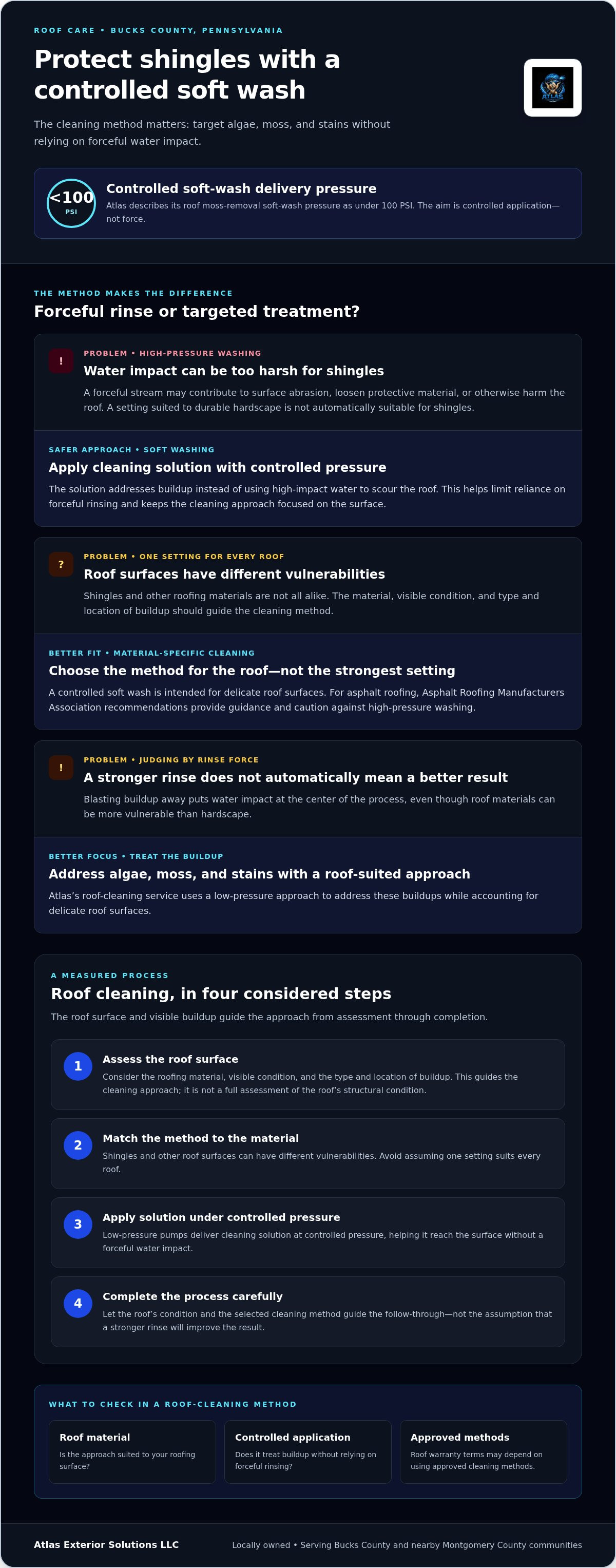
For roof moss removal, the soft-wash pressure used is under 100 PSI. The cleaning solution addresses the buildup, while low pressure limits reliance on forceful water impact. Atlas Exterior Solutions LLC uses an ARMA-approved, manufacturer-recommended approach for roof cleaning across Bucks County and nearby Montgomery County communities.
This guide explains what low pressure means in practice, how soft washing differs from pressure washing, and what to consider before service. It also covers roof materials, preparation, and runoff, so you know what to expect when arranging roof cleaning in Newtown, Yardley, Richboro, or elsewhere in the area.
Key Takeaways
- Low-pressure roof cleaning targets buildup without relying on forceful rinsing.
- Roof material and condition should guide the cleaning method.
- Before service, prepare access, move nearby items when practical, and share property-specific concerns.
- Atlas Exterior Solutions serves homeowners across Bucks and Montgomery Counties with locally owned, fully insured roof-cleaning service.
What Is Low-Pressure Roof Cleaning, and Why Does It Suit Bucks County Homes?
Roof cleaning removes algae, moss, and stains without relying on forceful rinsing that can damage shingles. Low pressure roof cleaning gently applies a cleaning solution to address buildup instead of using high-impact water to scour the roof. Atlas describes its roof soft-wash delivery pressure as under 100 PSI. The aim is controlled application, not force.
Shingles are not hardscape. Their protective surface can be vulnerable to unnecessary force, so the cleaning method should account for the roof’s material and condition. A controlled soft wash helps restore the roof’s appearance while limiting the risk of surface abrasion and shingle damage. It also avoids treating every exterior surface as if it can withstand the same pressure.
Low-pressure roof cleaning applies a targeted solution to address buildup; high-pressure washing relies on water impact that can be too harsh for shingles.
Soft washing is a low-pressure approach for cleaning delicate exterior materials. For background on the method, see What is soft washing? Atlas describes its roof-cleaning process as ARMA-approved and manufacturer-recommended. Because roof warranty terms may depend on approved cleaning methods, choosing an appropriate approach is a practical part of caring for both the roof and its appearance.
How Does Low-Pressure Roof Cleaning Differ from Pressure Washing?
Soft washing applies cleaning solution with controlled pressure. Pressure washing uses a stronger stream to remove grime through water impact. That force may suit some durable hardscape surfaces, but shingles have a different structure and can be more vulnerable. Excessive force can contribute to surface abrasion, loosen protective material, or otherwise harm the roof. Choose a method for the surface, not simply the strongest setting available.
What Roof Buildup Can Low-Pressure Cleaning Address?
Atlas’s roof-cleaning service addresses algae, moss, and stains with a low-pressure approach suited to delicate roof surfaces. The method treats the buildup instead of blasting it away, helping protect the shingles during cleaning. If you’re considering service for a home in Newtown, Yardley, or another Bucks County community, explore Atlas’s Bucks County roof cleaning service.
When assessing a roof-cleaning option, consider both appearance and surface protection. A stronger rinse does not automatically produce a better result. Ask how the application is controlled and whether the method is intended for your roofing material. That surface-first approach is central to careful roof maintenance.
How Low-Pressure Roof Cleaning Works, from Application to Rinse
A careful roof-cleaning visit follows a sequence rather than starting with a spray. The roof surface and visible buildup guide the approach. The cleaning solution is then applied with controlled pressure, and the process is completed with the roof material in mind. This measured approach addresses buildup without depending on forceful rinsing.
- Assess the roof surface. Consider the roofing material, visible condition, and type and location of buildup. These details help guide a suitable cleaning approach.
- Choose a material-specific method. Shingles and other roof surfaces can have different vulnerabilities. The method should suit the material rather than apply one setting to every roof.
- Apply the solution under controlled pressure. Low-pressure pumps deliver cleaning solutions at controlled pressure, allowing the solution to reach the surface without a forceful water impact.
- Complete the cleaning process carefully. The follow-through should reflect the roof’s condition and the cleaning method, not an assumption that a stronger rinse will improve the result.
What Happens Before the Cleaning Solution Is Applied?
Before application, the roof surface and visible buildup are assessed to help determine a suitable method. This step helps guide surface care; it is not a full assessment of the roof’s structural condition. Material-specific cleaning matters because a method suited to one roofing surface may not suit another.
How Is the Low-Pressure Method Applied?
The cleaning solution is applied in a controlled way, with pressure suited to the roof surface. Atlas describes its roof moss-removal soft-wash delivery pressure as under 100 PSI. This is a reference point for the method, not a direction to use a forceful stream. The cleaning process is guided by the roof’s material and condition.
For asphalt roofing, the Asphalt Roofing Manufacturers Association recommendations provide guidance on cleaning and caution against high-pressure washing. This supports the principle behind soft washing: apply cleaning solution with control and avoid using water impact to scour delicate roof surfaces.
The same controlled approach is central to Atlas’s low-pressure soft-washing service. Knowing the steps, from evaluating the surface to completing the treatment, helps you recognize a process designed around the roof rather than a rushed, forceful rinse.
Low-Pressure Roof Cleaning vs. High-Pressure Washing: What Protects Shingles?
Choosing a roof-cleaning method is not simply a matter of selecting more or less pressure. Shingles can be vulnerable to forceful water impact, so the method should suit the roofing material and the buildup being treated. Low pressure roof cleaning uses controlled solution application rather than relying on a strong stream to scour the surface. Pressure that works on durable hardscape is not automatically appropriate for a roof.
Application pressure
Soft washing applies cleaning solution at controlled, low pressure. High-pressure washing directs a forceful stream of water at the surface.
Surface suitability
Low-pressure application is intended for delicate roof surfaces. Higher-pressure methods may suit some durable surfaces, but shingles require a more careful approach.
Roof-protection consideration
Controlled application limits reliance on water impact that can contribute to surface abrasion or shingle damage. Forceful washing can place unnecessary stress on a roof surface.
Does Low Pressure Clean Effectively Without Blasting the Roof?
Yes. Gentle application does not mean the roof needs to be blasted afterward. The cleaning solution addresses buildup, while the method avoids using forceful water impact as a substitute for treatment. Cleaning is different from physically scouring a surface: abrasion can wear or disturb roofing material without making the method more suitable. Results depend on the roof material, condition, and type of buildup, so do not assume every home will have the same outcome.
Effectiveness depends on selecting and applying a suitable method, not on pressure alone. A roof with one type of surface or buildup may respond differently from another. A careful approach accounts for those differences and aims to address visible buildup while limiting unnecessary force. It does not guarantee that every stain will disappear completely or permanently.
How Can Cleaning Methods Affect a Roof Warranty?
A roof warranty is manufacturer or provider coverage whose validity may depend on using approved cleaning methods. Terms differ, so review the wording for your roof rather than assuming one rule applies to every home. Atlas describes its roof-cleaning approach as manufacturer-recommended, but that does not determine coverage under an individual warranty. If you have questions about your specific coverage, consult the warranty documentation.
For Bucks County homeowners, the practical takeaway is to match the cleaning method to the roof and avoid treating force as a measure of cleaning quality. Controlled application can address buildup without a high-impact rinse, while attention to surface differences supports a more protective approach.
Preparing for Roof Cleaning in Bucks County: Safety, Surfaces, and Runoff
A little preparation can help a roof-cleaning visit proceed smoothly and give the crew useful context about your property. You do not need to climb onto the roof or assess its condition yourself. Focus on access, nearby items, and sharing details that could affect work around the home.
What Should Homeowners Prepare Before a Roof-Cleaning Visit?
Before service, take these simple steps from the ground:
- Keep access points clear. Make areas around the home that the crew may need to reach accessible, and move vehicles if they are in the way.
- Move vulnerable items when practical. Relocate outdoor items near the work zone so they are less exposed during cleaning.
- Share property-specific concerns. Point out delicate exterior features, access limitations, or other details that could help the crew plan the work.
- Leave roof-level tasks to the crew. Do not climb up to inspect shingles or prepare the roof. The crew can assess the visible surface as part of its work.
These steps apply whether your home is in Newtown, Yardley, Richboro, Bensalem, Langhorne, Levittown, Horsham, Fairless Hills, or elsewhere in Bucks County or nearby Montgomery County. Clear communication helps with planning and keeps homeowners off a potentially hazardous roof.
Why Do Runoff and Local Conditions Matter?
Roof cleaning involves more than the surface overhead. A careful crew considers nearby building materials and where water may flow as it moves away from the roof. This helps account for surrounding surfaces and the property as a whole.
In Pennsylvania, runoff management is a consideration in exterior cleaning, including in relation to the Pennsylvania Clean Streams Law. Mentioning the law does not establish a specific requirement for every home or project. For homeowners, the practical point is that runoff deserves attention in a thoughtful service plan rather than being ignored after solution is applied.
Local conditions can also affect planning. A drought watch is a water-use condition to consider when a current local advisory applies. Conditions can change, so homeowners across Bucks and Montgomery Counties should consider advisories in effect at the time of service. Planning should account for the property and local circumstances, not just the visible roof buildup.
Clear access, advance communication, and attention to surrounding surfaces help with service planning. Share concerns before work begins, and leave technical roof assessment and cleaning tasks to the crew.
To learn more about professional low pressure roof cleaning, contact Atlas Exterior Solutions LLC today for reliable service throughout Bucks County.
Choose Local Low-Pressure Roof Cleaning with Atlas Exterior Solutions
Choosing a roof-cleaning service is about more than removing visible buildup. The method should suit the roof, and the work should be planned with care for the home and its surroundings. Atlas Exterior Solutions provides residential roof cleaning using low-pressure techniques to address algae, moss, and stains while helping protect delicate roof surfaces.
Atlas is locally owned and fully insured, serving homeowners throughout Bucks and Montgomery Counties. The company serves nearby communities including Newtown, Yardley, Richboro, Bensalem, Langhorne, Levittown, Horsham, and Fairless Hills. Its property-protection approach matches the cleaning method to the roof instead of treating it like a surface that needs forceful washing.
What Makes a Local, Insured Roof-Cleaning Team a Practical Choice?
A local team serving Bucks County and nearby Montgomery County works with homeowners across the area. Atlas’s fully insured status is an additional trust point when arranging exterior service at your home. Local ownership and insurance provide a clear basis for choosing a provider focused on residential property care. The cleaning approach should still be matched to the roof rather than applied as a one-setting-fits-all treatment.
When considering service, note what you want addressed, such as visible buildup, and any concerns about the roof or surrounding work area. Sharing relevant details about the property helps keep the conversation focused on your home and the service you need.
What Is the Next Step for Your Roof?
If algae, moss, or stains are affecting your roof’s appearance, Atlas provides residential roof cleaning using a controlled approach designed with the roof surface in mind. Homeowners in Bucks and Montgomery Counties can read the complete Bucks County roof-cleaning guide for more background on roof maintenance and the service.
Before requesting an estimate, note your home’s location, the visible buildup, and any property-specific concerns. You do not need to inspect the roof yourself. What you can see from the ground is a practical starting point for discussing whether low pressure roof cleaning suits your roof and its condition.
Make Roof Care a Thoughtful Next Step
Include your roof in regular home-maintenance planning. Note when you first noticed a change in its appearance and keep any questions about the roof together. These observations can make a service conversation more useful when you’re ready to discuss low pressure roof cleaning.
Atlas Exterior Solutions serves homeowners in Bucks and Montgomery Counties. Requesting an estimate is a straightforward way to discuss your property and the roof-cleaning service you need.
A considered maintenance plan can help you feel more prepared to care for your home over time.
Frequently Asked Questions
Is low-pressure roof cleaning safe for asphalt shingles?
It is a commonly recommended approach for asphalt shingles, but the roof’s existing condition still matters. If you can see missing, lifted, or visibly damaged shingles from the ground, mention them before arranging cleaning. Cleaning addresses surface buildup; it is not a repair for damaged roofing. Sharing what you observe gives the service team useful context before the work is planned.
Can low-pressure roof cleaning remove algae, moss, and roof stains?
Yes, it is used to address algae, moss, and stains, though results depend on the roof and type of buildup. A mark that remains after cleaning may not be removable buildup and could have another cause. Do not assume lingering discoloration means the roof needs a stronger wash. Describe the areas you have noticed so the cleaning approach can be considered in light of what is visible.
Does low-pressure roof cleaning affect a roof warranty?
Warranty terms vary, so the answer depends on the wording for your particular roof. Look for maintenance or cleaning instructions in the documents from the manufacturer or provider. A method described as manufacturer-recommended does not, by itself, determine whether a specific roof warranty applies to your home.
How is low-pressure roof cleaning different from soft washing?
For roof work, the terms often refer to the same general cleaning approach. “Soft washing” names the method, while “low-pressure roof cleaning” specifies its use on a roof. Focus on the practical details: whether the process is intended for roof surfaces and how the application is controlled.
Can roof runoff affect plants or nearby surfaces during cleaning?
Yes, runoff may reach nearby areas, depending on the home’s layout and where roof drainage flows. Before the visit, note the locations of downspouts, outdoor furnishings, or surfaces you are especially concerned about, then share those details with the crew. This helps identify areas around the property to consider during planning. Do not handle roof drainage or climb to inspect it yourself.
Is low-pressure roof cleaning suitable for every roof material?
No. A method that suits one roof surface may not be appropriate for another, and the roof’s condition matters too. If you know the roofing material from installation paperwork or home records, share that information when discussing service. If you do not know it, describe what you can see from the ground. The cleaning plan should account for the roof’s material rather than assume every roof is alike.
When should a Bucks County homeowner schedule roof cleaning?
Consider scheduling when you notice visible algae, moss, or staining you would like addressed. There is no single calendar date that applies to every roof, so base the decision on what you observe and your maintenance plans. If you are arranging other exterior work, mention the roof as well so you can discuss how it fits into your upkeep.
Disclaimer
The information on this blog is for general informational purposes only. Results may vary based on surface type, condition, and cleaning methods. Always follow manufacturer guidelines and use proper safety precautions. Atlas Exterior Solutions is not liable for any damages or losses resulting from the use of this information.


